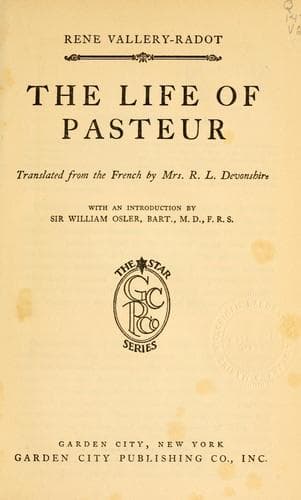
Pasteur, Louis, 1822-1895; Scientists -- France -- Biography
It might have been prophesied at that date that Pasteur’s surprised
delight at seeing his name gratefully inscribed on the great Italian
establishment of sericiculture would one day be surpassed by his
happiness in living to see realized some of the progress and benefits
due to him, his name invoked in all operating theatres, engraved over
the doors of medical and surgical wards, and a new era inaugurated.
A presentiment of the future deliverance of Humanity from those
redoubtable microscopic foes gave Pasteur a fever for work, a thirst for
new research, and an immense hope. But once again he constrained
himself, refrained from throwing himself into varied studies, and,
continuing what he had begun, reverted to his studies on splenic fever.
The neighbourhood of Chartres being most afflicted, the Minister of
Agriculture, anticipating the wish of the Conseil Général of the
department of Eure et Loir, had entrusted Pasteur with the mission of
studying the causes of so-called spontaneous charbon, that which bursts
out unexpectedly in a flock, and of seeking for curative and preventive
means of opposing the evil. Thirty-six years earlier, the learned
veterinary surgeon, Delafond, had been sent to seek, particularly in the
Beauce country, the causes of the charbon disease. Bouley, a great
reader, said that there was no contrast more instructive than that which
could be seen between the reasoning method followed by Delafond and the
experimental method practised by Pasteur. It was in 1842 that Delafond
received from M. Cunin Gridaine, then Minister of Agriculture, the
mission of “going to study that malady on the spot, to seek for its
causes, and to examine particularly whether those causes did not reside
in the mode of culture in use in that part of the country.” Delafond
arrived in the Beauce, and, having seen that the disease struck the
strongest sheep, it occurred to him that it came from “an excess of
blood circulating in the vessels.” He concluded from that that there
might be a correlation between the rich blood of the Beauce sheep and
the rich nitrogenous pasture of their food.
He therefore advised the cultivators to diminish the daily ration; and
he was encouraged in his views by noting that the frequency of the
disease diminished in poor, damp, or sandy soils.
Bouley, in order to show up Delafond’s efforts to make facts accord with
his reasoning, added that to explain “a disease, of which the essence is
general plethora, becoming contagious and expressing itself by charbon
symptoms in man,” Delafond had imagined that the atmosphere of the pens,
into which the animals were crowded, was laden with evil gases and
putrefying emanations which produced an alteration of the blood “due at
the same time to a slow asphyxia and to the introduction through the
lungs of septic elements into the blood.”
Public-domain text, read in full here on John Shaqi.
Reviews
Reviews
No reviews yet
Be the first to share your thoughts on this work.
Elsewhere in the archive
Join the Discussion
Join the discussion
Sign in to leave a comment or review.
Sign InorCreate an account