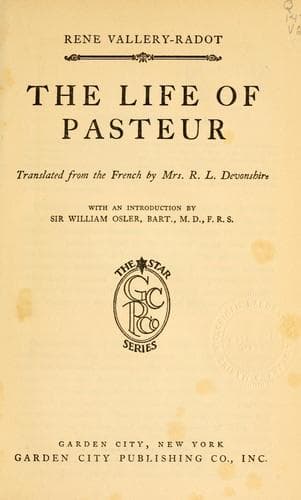
Pasteur, Louis, 1822-1895; Scientists -- France -- Biography
M. Roux had seen Pasteur try to “extract the soluble alcoholic ferment
from yeast cells by crushing them in a mortar, by freezing them until
they burst, or by putting them into concentrated saline solutions, in
order to force by osmose the succus to leave its envelope.” Pasteur
confessed that his efforts were vain. In a communication to the Académie
des Sciences on December 30, 1878, he said--
“It ever is an enigma to me that it should be believed that the
discovery of soluble ferments in fermentations properly so called, or of
the formation of alcohol by means of sugar, independently of cells
would hamper me. It is true--I own it without hesitation, and I am ready
to explain myself more lengthily if desired--that at present I neither
see the necessity for the existence of those ferments, nor the
usefulness of their action in this order of fermentations. Why should
actions of _diastase_, which are but phenomena of hydration, be confused
with those of organized ferments, or vice versâ? But I do not see that
the presence of those soluble substances, if it were ascertained, could
change in any way the conclusions drawn from my labours, and even less
so if alcohol were formed by electrolysis.
“They agree with me who admit:
“Firstly. That fermentations, properly so called, offer as an essential
condition the presence of microscopic organisms.
“Secondly. That those organisms have not a spontaneous origin.
“Thirdly. That the life of every organism which can exist away from free
oxygen is suddenly concomitant with acts of fermentation; and that it is
so with every cell which continues to produce chemical action without
the contact of oxygen.”
When Pasteur related this discussion, and formed of it an appendix to
his book, _Critical Examination of a Posthumous Work of Claude Bernard
on Fermentations_, his painful feelings in opposing a friend who was no
more were so clearly evidenced that Sainte Claire Deville wrote to him
(June 9, 1879): “My dear Pasteur, I read a few passages of your new book
yesterday to a small party of professors and _savants_. We all were much
moved by the expressions with which you praise our dear Bernard, and by
your feelings of friendship and pure fraternity.”
Sainte Claire Deville often spoke of his admiration for Pasteur’s
precision of thought, his forcible speech, the clearness of his
writings. As for J. B. Dumas, he called the attention of his colleagues
at the Académie Française to certain pages of that _Critical
Examination_. Though unaccustomed to those particular subjects, they
could not but be struck by the sagacity and ingenuity of Pasteur’s
researches, and by the eloquence inspired by his genius. A propos of
those ferment germs, which turn grape juice into wine, and from which he
had preserved his swathed bunches, Pasteur wrote--
Public-domain text, read in full here on John Shaqi.
Reviews
Reviews
No reviews yet
Be the first to share your thoughts on this work.
Elsewhere in the archive
Join the Discussion
Join the discussion
Sign in to leave a comment or review.
Sign InorCreate an account