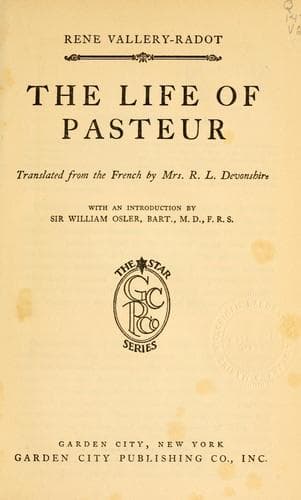
Pasteur, Louis, 1822-1895; Scientists -- France -- Biography
And, writing later, about the same passage: “Nowadays, if an article had
to be written on the same subject, it would certainly be the idea of
living ferments and microscopic beings and germs which would be
mentioned and discussed as a cause. That is the great progress,” added
Pasteur with legitimate pride, “in which my labours have had so large a
share. But it is characteristic of Science and Progress that they go on
opening new fields to our vision; the scientist, who is exploring the
unknown, resembles the traveller who perceives further and higher
summits as he reaches greater altitudes. In these days, more infectious
diseases, more microscopic beings appear to the mind as things to be
discovered, the discovery of which will render a wonderful account of
pathological conditions and of their means of action and propagation, of
self-multiplication within and destruction of the organism. The point of
view is very different from Littré’s!!”
On his return to Paris, Pasteur, his mind overflowing with ideas, had
felt himself impelled to speak again, to fight once more the fallacious
theory of the spontaneity of transmissible diseases. He foresaw the
triumph of the germ theory arising from the ruin of the old
doctrines--at the price, it is true, of many efforts, many struggles,
but those were of little consequence to him.
The power of his mind, the radiating gifts that he possessed, were such
that his own people were more and more interested in the laboratory,
every one trying day by day to penetrate further into Pasteur’s
thoughts. His family circle had widened; his son and his daughter had
married, and the two new-comers had soon been initiated into past
results and recent experiments. He had, in his childhood and youth, been
passionately loved by his parents and sisters, and now, in his middle
age, his tenderness towards his wife and children was eagerly repaid by
the love they bore him. He made happiness around him whilst he gave
glory to France.
CHAPTER X
1880--1882.
A new microbe now became the object of the same studies of culture and
inoculation as the bacillus anthracis. Readers of this book may have had
occasion to witness the disasters caused in a farmyard by a strange and
sudden epidemic. Hens, believed to be good sitters, are found dead on
their nests. Others, surrounded by their brood, allow the chicks to
leave them, giving them no attention; they stand motionless in the
centre of the yard, staggering under a deadly drowsiness. A young and
superb cock, whose triumphant voice was yesterday heard by all the
neighbours, falls into a sudden agony, his beak closed, his eyes dim,
his purple comb drooping limply. Other chickens, respited till the next
day, come near the dying and the dead, picking here and there grains
soiled with excreta containing the deadly germs: it is chicken cholera.
Public-domain text, read in full here on John Shaqi.
Reviews
Reviews
No reviews yet
Be the first to share your thoughts on this work.
Elsewhere in the archive
Join the Discussion
Join the discussion
Sign in to leave a comment or review.
Sign InorCreate an account