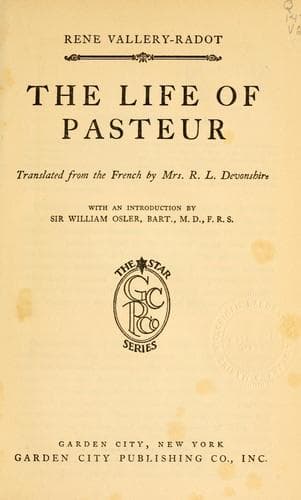
Pasteur, Louis, 1822-1895; Scientists -- France -- Biography
“The most decisive of all the proofs which can be invoked in favour of
the possible correlation between a determined affection and the presence
of a micro-organism, is that afforded by the method of cultures of
organisms in a state of purity; a method by which I have solved, within
the last twenty-two years, the chief difficulties relative to
fermentations properly so called; notably the important question, much
debated formerly, of the correlation which exists between those
fermentations and their particular ferments.”
He then pointed out that if, after gathering either blood or pus
immediately before or immediately after the death of a plague patient,
one could succeed in discovering the micro-organism, and then in finding
for that microbe an appropriate culture medium, it would be advisable to
inoculate with it animals of various kinds, perhaps monkeys for
preference, and to look for the lesions capable of establishing
relations from cause to effect between that organism and the disease in
mankind.
He did not hide from himself the great difficulties to be met with in
experimenting; for, after discovering and isolating the organism, there
is nothing to indicate _a priori_ to the experimentalist an appropriate
culture medium. Liquids which suit some microbes admirably are
absolutely unsuitable to others. Take, for instance, the microbe of
chicken-cholera, which will not develop in beer yeast; a hasty
experimentalist might conclude that the chicken-cholera is not produced
by a micro-organism, and that it is a spontaneous disease with unknown
immediate causes. “The fallacy would be a fatal one,” said Pasteur, “for
in another medium, say, for instance, in chicken-broth, there would be a
virulent culture.”
In these researches on the plague, then, various mediums should be
tried; also the character, either aërobic or anaërobic, of the microbe
should be present to the mind.
“The sterility of a culture liquid may come from the presence of air and
not from its own constitution; the septic vibrio, for instance, is
killed by oxygen in air. From this last circumstance it is plain that
culture must be made not only in the presence of air but also in a
vacuum or in the presence of pure carbonic acid gas. In the latter case,
immediately after sowing the blood or humour to be tested, a vacuum must
be made in the tubes, they must be sealed by means of a lamp, and left
in a suitable temperature, usually between 30° C. and 40° C.” Thus he
prepared landmarks for the guidance of scientific research on the
etiology of the plague.
* * * * *
Desiring as Pasteur did that the public in general should take an
interest in laboratory research, he sent to his friend Nisard the number
of the _Bulletin of the Académie de Médecine_ which contained a first
communication on chicken-cholera, and also his paper on the plague.
Public-domain text, read in full here on John Shaqi.
Reviews
Reviews
No reviews yet
Be the first to share your thoughts on this work.
Elsewhere in the archive
Join the Discussion
Join the discussion
Sign in to leave a comment or review.
Sign InorCreate an account