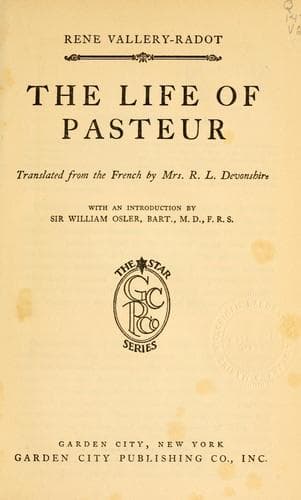
Pasteur, Louis, 1822-1895; Scientists -- France -- Biography
Vaccination candidates and unvaccinated test sheep were divided under a
large shed. For the injection of the vaccinal liquid, Pravaz’s little
syringe was used; those who have experienced morphia injections know how
easily the needle penetrates the subcutaneous tissues. Each of the
twenty-five sheep received, on the inner surface of the right thigh,
five drops of the bacteridian culture which Pasteur called the first
vaccine. Five cows and one ox substituted for the sixth cow were
vaccinated in their turn, behind the shoulder. The ox and the cows were
marked on the right horn, and the sheep on the ear.
Pasteur was, after this, asked to give a lecture on splenic fever in the
large hall of the Pouilly farm. Then, in clear, simple language, meeting
every objection half-way, showing no astonishment at ignorance or
prejudice, knowing perfectly well that many were really hoping for a
failure, he methodically described the road already travelled, and
pointed to the goal he would reach. For nearly an hour he interested and
instructed his mixed audience; he made them feel the genuineness of his
faith, and, besides his interest in the scientific problem, his desire
to spare heavy losses to cultivators. After the lecture, some, better
informed than others, were admiring the logical harmony of that career,
mingling with pure science results of incalculable benefit to the
public, an extraordinary alliance which gave a special moral physiognomy
to this man of prodigious labours.
An appointment was made for the second inoculation. In the interval--on
May 6, 7, 8 and 9--Messrs. Chamberland and Roux came to Pouilly le Fort
to take the temperature of the vaccinated animals, and found nothing
abnormal. On May 17 a second inoculation was made with a liquid which,
though still attenuated, was more virulent than the first. If that
liquid had been inoculated to begin with it would have caused a
mortality of 50 per 100.
“On Tuesday, May 31,” wrote Pasteur to his son-in-law, “the third and
last inoculation will take place--this time with fifty sheep and ten
cows. I feel great confidence--for the two first, on the 5th and the
17th, have been effected under the best conditions without any mortality
amongst the twenty-five vaccinated subjects. On June 5 at latest the
final result will be known, and should be twenty-five survivors out of
twenty-five vaccinated, and six cows. If the success is complete, this
will be one of the finest examples of applied science in this century,
consecrating one of the greatest and most fruitful discoveries.”
This great experiment did not hinder other studies being pursued in the
laboratory. The very day of the second inoculation at Pouilly le Fort,
Mme. Pasteur wrote to her daughter, “One of the laboratory dogs seems to
be sickening for hydrophobia; it seems that that would be very lucky, in
view of the interesting experiment it would provide.”
Public-domain text, read in full here on John Shaqi.
Reviews
Reviews
No reviews yet
Be the first to share your thoughts on this work.
Elsewhere in the archive
Join the Discussion
Join the discussion
Sign in to leave a comment or review.
Sign InorCreate an account