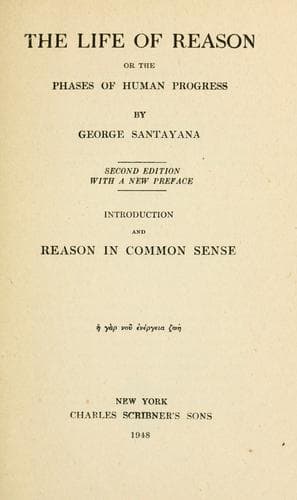
The Life of Reason: The Phases of Human ProgressSantayana, George
Philosophy
The Life of Reason: The Phases of Human Progress
Santayana, George
Philosophy
These natural phenomena, unintelligently regarded as anomalies and
abuses, are the appanage of war in its pristine and proper form. To
fight is a radical instinct; if men have nothing else to fight over they
will fight over words, fancies, or women, or they will fight because
they dislike each other’s looks, or because they have met walking in
opposite directions. To knock a thing down, especially if it is cocked
at an arrogant angle, is a deep delight to the blood. To fight for a
reason and in a calculating spirit is something your true warrior
despises; even a coward might screw his courage up to such a reasonable
conflict. The joy and glory of fighting lie in its pure spontaneity and
consequent generosity; you are not fighting for gain, but for sport and
for victory. Victory, no doubt, has its fruits for the victor. If
fighting were not a possible means of livelihood the bellicose instinct
could never have established itself in any long-lived race. A few men
can live on plunder, just as there is room in the world for some beasts
of prey; other men are reduced to living on industry, just as there are
diligent bees, ants, and herbivorous kine. But victory need have no good
fruits for the people whose army is victorious. That it sometimes does
so is an ulterior and blessed circumstance hardly to be reckoned upon.
[Sidenote: Barrack-room philosophy.]
Since barbarism has its pleasures it naturally has its apologists. There
are panegyrists of war who say that without a periodical bleeding a race
decays and loses its manhood. Experience is directly opposed to this
shameless assertion. It is war that wastes a nation’s wealth, chokes its
industries, kills its flower, narrows its sympathies, condemns it to be
governed by adventurers, and leaves the puny, deformed, and unmanly to
breed the next generation. Internecine war, foreign and civil, brought
about the greatest set-back which the Life of Reason has ever suffered;
it exterminated the Greek and Italian aristocracies. Instead of being
descended from heroes, modern nations are descended from slaves; and it
is not their bodies only that show it. After a long peace, if the
conditions of life are propitious, we observe a people’s energies
bursting their barriers; they become aggressive on the strength they
have stored up in their remote and unchecked development. It is the
unmutilated race, fresh from the struggle with nature (in which the best
survive, while in war it is often the best that perish) that descends
victoriously into the arena of nations and conquers disciplined armies
at the first blow, becomes the military aristocracy of the next epoch
and is itself ultimately sapped and decimated by luxury and battle, and
merged at last into the ignoble conglomerate beneath. Then, perhaps, in
some other virgin country a genuine humanity is again found, capable of
victory because unbled by war. To call war the soil of courage and
virtue is like calling debauchery the soil of love.
Public-domain text, read in full here on John Shaqi.
Reviews
Reviews
No reviews yet
Be the first to share your thoughts on this work.
Elsewhere in the archive
Join the Discussion
Join the discussion
Sign in to leave a comment or review.
Sign InorCreate an account