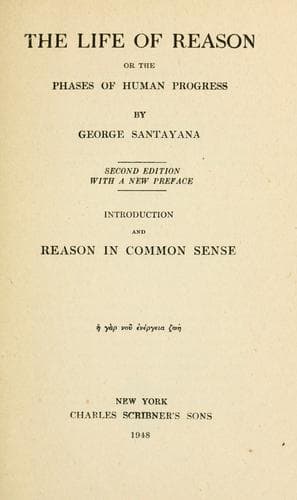
The Life of Reason: The Phases of Human ProgressSantayana, George
Philosophy
The Life of Reason: The Phases of Human Progress
Santayana, George
Philosophy
For an ideal aristocracy we should not look to Plato’s Republic, for
that Utopia is avowedly the ideal only for fallen and corrupt states,
since luxury and injustice, we are told, first necessitated war, and the
guiding idea of all the Platonic regimen is military efficiency.
Aristocracy finds a more ideal expression in theism; for theism imagines
the values of existence to be divided into two unequal parts: on the one
hand the infinite value of God’s life, on the other the finite values of
all the created hierarchy. According to theistic cosmology, there was a
metaphysical necessity, if creatures were to exist at all, that they
should be in some measure inferior to godhead; otherwise they would have
been indistinguishable from the godhead itself according to the
principle called the identity of indiscernibles, which declares that two
beings exactly alike cannot exist without collapsing into an undivided
unit. The propagation of life involved, then, declension from pure
vitality, and to diffuse being meant to dilute it with nothingness. This
declension might take place in infinite degrees, each retaining some
vestige of perfection mixed, as it were, with a greater and greater
proportion of impotence and nonentity. Below God stood the angels, below
them man, and below man the brute and inanimate creation. Each sphere,
as it receded, contained a paler adumbration of the central perfection;
yet even at the last confines of existence some feeble echo of divinity
would still resound. This inequality in dignity would be not only a
beauty in the whole, to whose existence and order such inequalities
would be essential, but also no evil to the creature and no injustice;
for a modicum of good is not made evil simply because a greater good is
elsewhere possible. On the contrary, by accepting that appointed place
and that specific happiness, each servant of the universal harmony could
feel its infinite value and could thrill the more profoundly to a music
which he helped to intone.
[Sidenote: A heaven with many mansions.]
Dante has expressed this thought with great simplicity and beauty. He
asks a friend’s spirit, which he finds lodged in the lowest circle of
paradise, if a desire to mount higher does not sometimes visit him; and
the spirit replies:
Public-domain text, read in full here on John Shaqi.
Reviews
Reviews
No reviews yet
Be the first to share your thoughts on this work.
Elsewhere in the archive
Join the Discussion
Join the discussion
Sign in to leave a comment or review.
Sign InorCreate an account