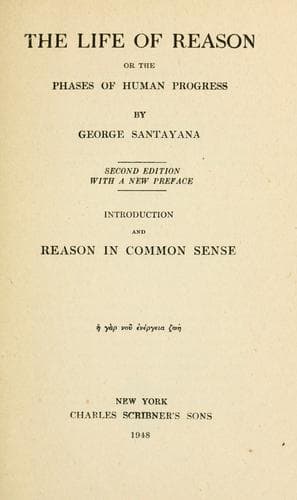
The Life of Reason: The Phases of Human ProgressSantayana, George
Philosophy
The Life of Reason: The Phases of Human Progress
Santayana, George
Philosophy
Such a timocracy (of which the Roman Church is a good example) would
differ from the social aristocracy that now exists only by the removal
of hereditary advantages. People would be born equal, but they would
grow unequal, and the only equality subsisting would be equality of
opportunity. If power remained in the people’s hands, the government
would be democratic; but a full development of timocracy would allow the
proved leader to gain great ascendancy. The better security the law
offered that the men at the top should be excellent, the less restraint
would it need to put upon them when once in their places. Their eminence
would indeed have been factitious and their station undeserved if they
were not able to see and do what was requisite better than the community
at large. An assembly has only the lights common to the majority of its
members, far less, therefore, than its members have when added together
and less even than the wiser part of them.
A timocracy would therefore seem to unite the advantages of all forms of
government and to avoid their respective abuses. It would promote
freedom scientifically. It might be a monarchy, if men existed fit to
be kings; but they would have to give signs of their fitness and their
honours would probably not be hereditary. Like aristocracy, it would
display a great diversity of institutions and superposed classes, a
stimulating variety in ways of living; it would be favourable to art and
science and to noble idiosyncrasies. Among its activities the
culminating and most conspicuous ones would be liberal. Yet there would
be no isolation of the aristocratic body; its blood would be drawn from
the people, and only its traditions from itself. Like social democracy,
finally, it would be just and open to every man, but it would not
depress humanity nor wish to cast everybody in a common mould.
[Sidenote: The difficulty the same as in all Socialism.]
Public-domain text, read in full here on John Shaqi.
Reviews
Reviews
No reviews yet
Be the first to share your thoughts on this work.
Elsewhere in the archive
Join the Discussion
Join the discussion
Sign in to leave a comment or review.
Sign InorCreate an account