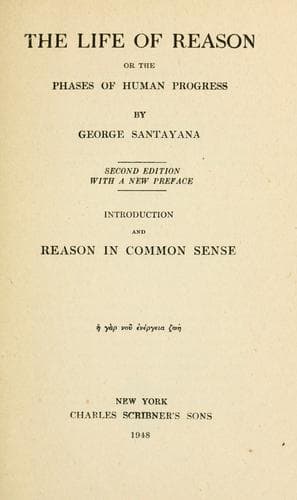
The Life of Reason: The Phases of Human ProgressSantayana, George
Philosophy
The Life of Reason: The Phases of Human Progress
Santayana, George
Philosophy
The question here suggests itself whether such a citizen, once having
accepted his humble lot, would be in a different position from the
plebeians in an aristocracy. The same subordination would be imposed
upon him, only the ground assigned for his submission would be no longer
self-interest and necessity, but patriotic duty. This patriotism would
have to be of an exalted type. Its end would not be, as in industrial
society, to secure the private interests of each citizen; its end would
be the glory and perfection of the state as imagination or philosophy
might conceive them. This glory and perfection would not be a benefit to
anyone who was not in some degree a philosopher and a poet. They would
seem, then, to be the special interests of an aristocracy, not indeed an
aristocracy of wealth or power, but an aristocracy of noble minds.
Those whose hearts could prize the state’s ideal perfection would be
those in whom its benefits would be integrated. And the common citizen
would find in their existence, and in his own participation in their
virtue, the sole justification for his loyalty.
Ideal patriotism is not secured when each man, although without natural
eminence, pursues his private interests. What renders man an imaginative
and moral being is that in society he gives new aims to his life which
could not have existed in solitude: the aims of friendship, religion,
science, and art. All these aims, in a well-knit state, are covered by
the single passion of patriotism; and then a conception of one’s
country, its history and mission becomes the touchstone of every ideal
impulse. Timocracy requires this kind of patriotism in everybody; so
that if public duty is not to become a sacrifice imposed on the many for
the sake of the few, as in aristocracy, the reason can only be that the
many covet, appreciate, and appropriate their country’s ideal glories,
quite as much as the favoured class ever could in any aristocracy.
[Sidenote: Organisation for ideal ends breeds fanaticism.]
Public-domain text, read in full here on John Shaqi.
Reviews
Reviews
No reviews yet
Be the first to share your thoughts on this work.
Elsewhere in the archive
Join the Discussion
Join the discussion
Sign in to leave a comment or review.
Sign InorCreate an account