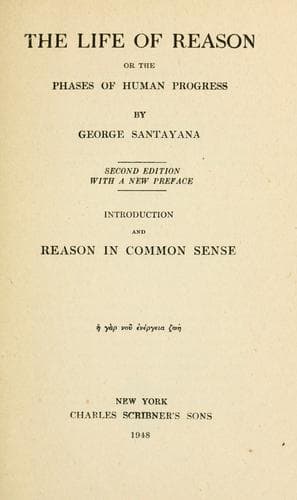
The Life of Reason: The Phases of Human ProgressSantayana, George
Philosophy
The Life of Reason: The Phases of Human Progress
Santayana, George
Philosophy
Natural society unites beings in time and space; it fixes affection on
those creatures on which we depend and to which our action must be
adapted. Natural society begins at home and radiates over the world, as
more and more things become tributary to our personal being. In marriage
and the family, in industry, government, and war, attention is riveted
on temporal existences, on the fortunes of particular bodies, natural or
corporate. There is then a primacy of nature over spirit in social life;
and this primacy, in a certain sense, endures to the end, since all
spirit must be the spirit of something, and reason could not exist or be
conceived at all unless a material organism, personal or social, lay
beneath to give thought an occasion and a point of view, and to give
preference a direction. Things could not be near or far, worse or
better, unless a definite life were taken as a standard, a life lodged
somewhere in space and time. Reason is a principle of order appearing in
a subject-matter which in its subsistence and quantity must be an
irrational datum. Reason expresses purpose, purpose expresses impulse,
and impulse expresses a natural body with self-equilibrating powers.
At the same time, natural growths may be called achievements only
because, when formed, they support a joyful and liberal experience.
Nature’s works first acquire a meaning in the commentaries they provoke;
mechanical processes have interesting climaxes only from the point of
view of the life that expresses them, in which their ebb and flow grows
impassioned and vehement. Nature’s values are imputed to her
retroactively by spirit, which in its material dependence has a logical
and moral primacy of its own. In themselves events are perfectly
mechanical, steady, and fluid, not stopping where we see a goal nor
avoiding what we call failures. And so they would always have remained
in crude experience, if no cumulative reflection, no art, and no science
had come to dominate and foreshorten that equable flow of substance,
arresting it ideally in behalf of some rational interest.
Thus it comes to pass that rational interests have a certain ascendancy
in the world, as well as an absolute authority over it; for they arise
where an organic equilibrium has naturally established itself. Such an
equilibrium maintains itself by virtue of the same necessity that
produced it; without arresting the flux or introducing any miracle, it
sustains in being an ideal form. This form is what consciousness
corresponds to and raises to actual existence; so that significant
thoughts are something which nature necessarily lingers upon and seems
to serve. The being to whom they come is the most widely based and
synthetic of her creatures. The mind spreads and soars in proportion as
the body feeds on the surrounding world. Noble ideas, although rare and
difficult to attain, are not naturally fugitive.
[Sidenote: All experience at bottom liberal.]
Public-domain text, read in full here on John Shaqi.
Reviews
Reviews
No reviews yet
Be the first to share your thoughts on this work.
Elsewhere in the archive
Join the Discussion
Join the discussion
Sign in to leave a comment or review.
Sign InorCreate an account