In his personal appearance, Sir Isaac Newton was not above the
middle size, and in the latter part of his life was inclined to be
corpulent. According to Mr. Conduit “he had a very lively and piercing
eye, a comely and gracious aspect, with a fine head of hair as white
as silver, without any baldness, and when his peruke was off was a
venerable sight.” Bishop Atterbury asserts,[132] on the other hand,
that the lively and piercing eye did not belong to Sir Isaac during the
last twenty years of his life. “Indeed,” says he, “in the whole air
of his face and make there was nothing of that penetrating sagacity
which appears in his compositions. He had something rather languid in
his look and manner which did not raise any great expectation in those
who did not know him.” This opinion of Bishop Atterbury is confirmed
by an observation of Mr. Thomas Hearne,[133] who says “that Sir Isaac
was a man of no very promising aspect. He was a short, well-set man.
He was full of thought, and spoke very little in company, so that his
conversation was not agreeable. When he rode in his coach, one arm
would be out of his coach on one side and the other on the other.” Sir
Isaac never wore spectacles, and never “lost more than one tooth to the
day of his death.”
Besides the statue of Sir Isaac Newton executed by Roubiliac, there is
a bust of him by the same artist in the library of Trinity College,
Cambridge. Several good paintings of him are extant. Two of these are
in the hall of the Royal Society of London, and have, we believe, been
often engraved. Another, by Vanderbank, is in the apartments of the
Master’s lodge in Trinity College, and has been engraved by Vertue.
Another, by Valentine Ritts, is in the landing-place near the entrance
to Trinity College library; but the best, from which our engraving is
copied, was painted by Sir Godfrey Kneller, and is in the possession of
Lord Egremont at Petworth. In the university library there is preserved
a cast taken from his face after death.
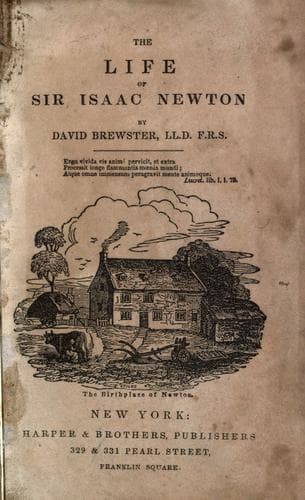
Every memorial of so great a man as Sir Isaac Newton has been preserved
and cherished with peculiar veneration. His house at Woolsthorpe,
of which we have given an engraving, has been religiously protected
by Mr. Turnor of Stoke Rocheford, the proprietor. Dr. Stukeley, who
visited it in Sir Isaac’s lifetime, on the 13th October, 1721, gives
the following description of it in his letter to Dr. Mead, written in
1727: “’Tis built of stone as is the way of the country hereabouts, and
a reasonable good one. They led me up stairs and showed me Sir Isaac’s
study, where I suppose he studied when in the country in his younger
days, or perhaps when he visited his mother from the university. I
observed the shelves were of his own making, being pieces of deal
boxes which probably he sent his books and clothes down in on those
occasions. There were some years ago two or three hundred books in it
of his father-in-law, Mr. Smith, which Sir Isaac gave to Dr. Newton of
our town.”[134]
Public-domain text, read in full here on John Shaqi.
Reviews
Reviews
No reviews yet
Be the first to share your thoughts on this work.
Elsewhere in the archive
Join the Discussion
Join the discussion
Sign in to leave a comment or review.
Sign InorCreate an account