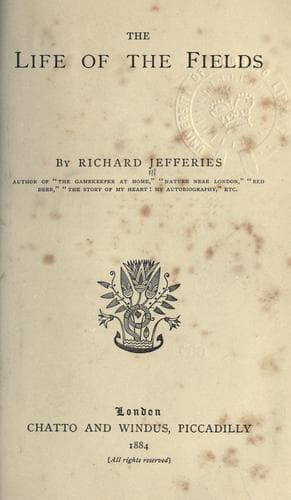
Natural history -- Outdoor books; Nature; Nature study; Paris (France) -- Description and travel
All broader effects of colour must in winter be looked for in the
atmosphere, as the light changes, as the mist passes, as the north wind
brings down a blackness, or the gust dries up the furrow; as the colour
of the air alters, for it is certain that the air is often full of
colour. To the atmosphere we must look for all broader effects. Specks
of detail may be sometimes discerned, one or two in a walk, as the
white breasts of the lapwings on the dark ploughed ridges; yellow
oat-straw by the farm, still retaining the golden tint of summer; if
fortunate, a blue kingfisher by the brook, and always dew flashing
emerald and ruby.
JANUARY IN THE SUSSEX WOODS
The lost leaves measure our years; they are gone as the days are gone,
and the bare branches silently speak of a new year, slowly advancing to
its buds, its foliage, and fruit. Deciduous trees associate with human
life as this yew never can. Clothed in its yellowish-green needles, its
tarnished green, it knows no hope or sorrow; it is indifferent to
winter, and does not look forward to summer. With their annual loss of
leaves, and renewal, oak and elm and ash and beech seem to stand by us
and to share our thoughts. There is no wind at the edge of the wood,
and the few flakes of snow that fall from the overcast sky flutter as
they drop, now one side higher and then the other, as the leaves did in
the still hours of autumn. The delicacy of the outer boughs of the
great trees visible against the dark background of cloud is as
beautiful in its own way as the massed foliage of summer. Each slender
bough is drawn out to a line; line follows line as shade grows under
the pencil, but each of these lines is separate. Great boles of beech,
heavy timber at the foot, thus end at their summits in the lightest and
most elegant pencilling. Where the birches are tall, sometimes the
number and closeness of these bare sprays causes a thickening almost as
if there were leaves there. The leaves, in fact, when they come,
conceal the finish of the trees; they give colour, but they hide the
beautiful structure under them. Each tree at a distance is recognisable
by its particular lines; the ash, for instance, grows with its own
marked curve.
Public-domain text, read in full here on John Shaqi.
Reviews
Reviews
No reviews yet
Be the first to share your thoughts on this work.
Elsewhere in the archive
Join the Discussion
Join the discussion
Sign in to leave a comment or review.
Sign InorCreate an account