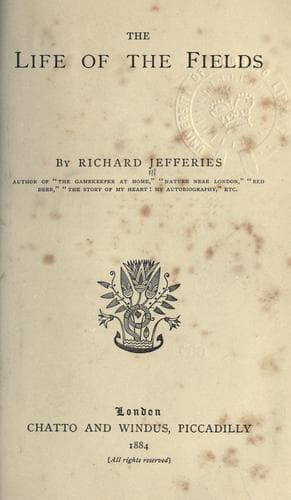
Natural history -- Outdoor books; Nature; Nature study; Paris (France) -- Description and travel
Some little green stays on the mounds where the rabbits creep and
nibble the grasses. Cinquefoil remains green though faded, and wild
parsley the freshest looking of all; plantain leaves are found under
shelter of brambles, and the dumb nettles, though the old stalks are
dead, have living leaves at the ground. Grey-veined ivy trails along,
here and there is a frond of hart's-tongue fern, though withered at the
tip, and greenish grey lichen grows on the exposed stumps of trees.
These together give a green tint to the mound, which is not so utterly
devoid of colour as the season of the year might indicate. Where they
fail, brown brake fern fills the spaces between the brambles; and in a
moist spot the bunches of rushes are composed half of dry stalks, and
half of green. Stems of willow-herb, four feet high, still stand, and
tiny long-tailed tits perch sideways on them. Above, on the bank,
another species of willow-herb has died down to a short stalk, from
which springs a living branch, and at its end is one pink flower. A
dandelion is opening on the same sheltered bank; farther on the gorse
is sprinkled with golden spots of bloom. A flock of greenfinches starts
from the bushes, and their colour shows against the ruddy wands of the
osier-bed over which they fly. The path winds round the edge of the
wood, where a waggon track goes up the hill; it is deeply grooved at
the foot of the hill. These tracks wear deeply into the chalk just
where the ascent begins. The chalk adheres to the shoes like mortar,
and for some time after one has left it each footstep leaves a white
mark on the turf. On the ridge the low trees and bushes have an outline
like the flame of a candle in a draught--the wind has blown them till
they have grown fixed in that shape. In an oak across the ploughed
field a flock of wood-pigeons have settled; on the furrows there are
chaffinches, and larks rise and float a few yards farther away. The
snow has ceased, and though there is no wind on the surface, the clouds
high above have opened somewhat, not sufficient for the sun to shine,
but to prolong the already closing afternoon a few minutes. If the sun
shines to-morrow morning the lark will soar and sing, though it is
January, and the quick note of the chaffinch will be heard as he
perches on the little branches projecting from the trunks of trees
below the great boughs. Thrushes sing every mild day in December and
January, entirely irrespective of the season, also before rain.
Public-domain text, read in full here on John Shaqi.
Reviews
Reviews
No reviews yet
Be the first to share your thoughts on this work.
Elsewhere in the archive
Join the Discussion
Join the discussion
Sign in to leave a comment or review.
Sign InorCreate an account