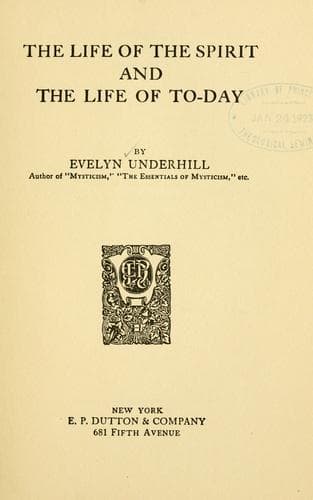
The Life of the Spirit and the Life of To-dayUnderhill, Evelyn
Religion
The Life of the Spirit and the Life of To-day
Underhill, Evelyn
Spiritual life
Our greatest difficulty abides in the fact that, as we have seen, a
vigorous spiritual life must give scope to the emotions. It is above all
the heart rather than the mind which must be won for God. Yet, the
greatest care must be exercised to ensure that the appeal to the
emotions is free from all possibility of appeal to latent and
uncomprehended natural instincts. This peril, to which current
psychology gives perhaps too much attention, is nevertheless real.
Candid students of religious history are bound to acknowledge the
unfortunate part which it has often played in the past. These natural
instincts fall into two great classes: those relating to
self-preservation and those relating to the preservation of the race.
The note of fear, the exaggerated longing for shelter and protection,
the childish attitude of mere clinging dependence, fostered by religion
of a certain type, are all oblique expressions of the instinct of
self-preservation: and the rather feverish devotional moods and
exuberant emotional expressions with which we are all familiar have,
equally, a natural origin. Our task in the training of young people is
to evoke enthusiasm, courage and love, without appealing to either of
these sources of excitement. Generally speaking, it is safe to say that
for this reason all sentimental and many anthropomorphic religious ideas
are bad for lads and girls. These have, indeed, no part in that austere
yet ardent love of God which inspires the real spiritual life.
Our aim ought to be, to teach and impress the reality of Spirit, its
regnancy in human life, whilst the mind is alert and supple: and so to
teach and impress it, that it is woven into the stuff of the mental and
moral life and cannot seriously be injured by the hostile criticisms of
the rationalist. Remember, that the prime object of education is the
moulding of the unconscious and instinctive nature, the home of habit.
If we can give this the desired tendency and tone of feeling, we can
trust the rational mind to find good reasons with which to reinforce its
attitudes and preferences. So it is not so much the specific belief, as
the whole spiritual attitude to existence which we seek to affirm; and
this will be done on the whole more effectively by the generalized
suggestions which come to the pupil from his own surroundings, and the
lives of those whom he admires, than by the limited and special
suggestions of a creed. It is found that the less any desired motive is
bound up with particular acts, persons, or ideas, the greater is the
chance of its being universalized and made good for life all round. I do
not intend by this statement to criticize any particular presentation
of religion. Nevertheless, educators ought to remember that a religion
which is first entirely bound up with narrow and childish theological
ideas, and is then presented as true in the absolute sense, is bound to
break down under greater knowledge or hostile criticism; and may then
Public-domain text, read in full here on John Shaqi.
Reviews
Reviews
No reviews yet
Be the first to share your thoughts on this work.
Elsewhere in the archive
Join the Discussion
Join the discussion
Sign in to leave a comment or review.
Sign InorCreate an account