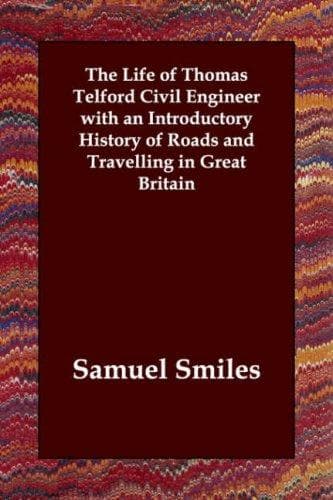
The Life of Thomas Telford, Civil Engineer: With an Introductory History of Roads and Travelling in Great BritainSmiles, Samuel
History
The Life of Thomas Telford, Civil Engineer: With an Introductory History of Roads and Travelling in Great Britain
Smiles, Samuel
Civil engineers -- Great Britain -- Biography; Roads -- Great Britain; Telford, Thomas, 1757-1834
When the engineer proceeded to dispose of his savings by will,
which he did a few months before his death, the distribution was a
comparatively easy matter. The total amount of his bequeathments
was 16,600L.*[13] About one-fourth of the whole he set apart for
educational purposes, --2000L. to the Civil Engineers' Institute,
and 1000L. each to the ministers of Langholm and Westerkirk, in
trust for the parish libraries. The rest was bequeathed, in sums
of from 200L. to 500L., to different persons who had acted as
clerks, assistants, and surveyors, in his various public works; and
to his intimate personal friends. Amongst these latter were Colonel
Pasley, the nephew of his early benefactor; Mr. Rickman, Mr. Milne,
and Mr. Hope, his three executors; and Robert Southey and Thomas
Campbell, the poets. To both of these last the gift was most
welcome. Southey said of his: "Mr. Telford has most kindly and
unexpectedly left me 500L., with a share of his residuary property,
which I am told will make it amount in all to 850L. This is truly a
godsend, and I am most grateful for it. It gives me the comfortable
knowledge that, if it should please God soon to take me from this
world, my family would have resources fully sufficient for their
support till such time as their affairs could be put in order, and
the proceeds of my books, remains, &c., be rendered available.
I have never been anxious overmuch, nor ever taken more thought for
the morrow than it is the duty of every one to take who has to earn
his livelihood; but to be thus provided for at this time I feel to
be an especial blessing.'"*[14] Among the most valuable results of
Telford's bequests in his own district, was the establishment of
the popular libraries at Langholm and Westerkirk, each of which now
contains about 4000 volumes. That at Westerkirk had been
originally instituted in the year 1792, by the miners employed to
work an antimony mine (since abandoned) on the farm of Glendinning,
within sight of the place where Telford was born. On the
dissolution of the mining company, in 1800, the little collection
of books was removed to Kirkton Hill; but on receipt of Telford's
bequest, a special building was erected for their reception at Old
Bentpath near the village of Westerkirk. The annual income derived
from the Telford fund enabled additions of new volumes to be made
to it from time to time; and its uses as a public institution were
thus greatly increased. The books are exchanged once a month, on
the day of the full moon; on which occasion readers of all ages and
conditions,--farmers, shepherds, ploughmen, labourers, and their
children,--resort to it from far and near, taking away with them as
many volumes as they desire for the month's readings.
Public-domain text, read in full here on John Shaqi.
Reviews
Reviews
No reviews yet
Be the first to share your thoughts on this work.
Elsewhere in the archive
Join the Discussion
Join the discussion
Sign in to leave a comment or review.
Sign InorCreate an account