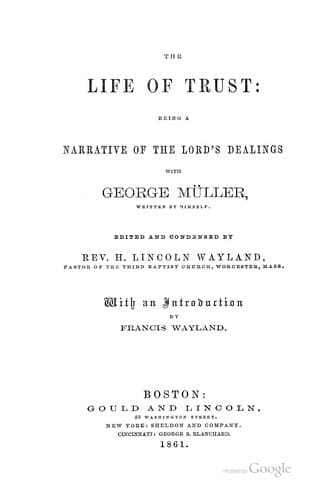
The Life of Trust: Being a Narrative of the Lord's Dealings With George MüllerMüller, George
Religion
The Life of Trust: Being a Narrative of the Lord's Dealings With George Müller
Müller, George
Orphanages -- Great Britain; Prayer
Jan. 13. This evening I was called to the house of a brother and sister
who are in the deepest distress. The brother had become surety for the
debts of his son, not in the least expecting that he ever should be
called upon for the payment of them; but, as his son has not discharged
his debts, the father has been called upon to do so; and except the
money is paid within a few days, he will be imprisoned.
How precious it is, even for this life, to act according to the word of
God! This perfect revelation of his mind gives us directions for
everything, even the most minute affairs of this life. It commands us,
"Be not thou one of them that strike hands, or of them that are sureties
for debts." Prov. xxii. 26. The way in which Satan ensnares persons, to
bring them into the net, and to bring trouble upon them by becoming
sureties, is, that he seeks to represent the matter as if there were no
danger connected with that particular case, and that one might be sure
one should never be called upon to pay the money; but the Lord, the
faithful Friend, tells us in his own word that the only way "to be sure"
in such a matter is "to hate suretyship." Prov. xi. 15. The following
points seem to me of solemn moment for consideration, if I were called
upon to become surety for another: 1. What obliges the person who wishes
me to become surety for him to need a surety? Is it really a good cause
in which I am called upon to become surety? I do not remember ever to
have met with a case in which in a plain, and godly, and in all respects
scriptural matter such a thing occurred. There was generally some sin or
other connected with it. 2. If I become surety, notwithstanding what the
Lord has said to me in his word, am I in such a position that no one
will be injured by my being called upon to fulfil the engagements of the
person for whom I am going to be surety? In most instances this alone
ought to keep one from it. 3. If still I become surety, the amount of
money for which I become responsible must be so in my power that I am
able to produce it whenever it is called for, in order that the name of
the Lord may not be dishonored. 4. But if there be the possibility of
having to fulfil the engagements of the person in whose stead I have to
stand, is it the will of the Lord that I should spend my means in that
way? Is it not rather his will that my means should be spent in another
way? 5. How can I get over the plain word of the Lord, which is to the
contrary, even if the first four points could be satisfactorily settled?
Public-domain text, read in full here on John Shaqi.
Reviews
Reviews
No reviews yet
Be the first to share your thoughts on this work.
Elsewhere in the archive
Join the Discussion
Join the discussion
Sign in to leave a comment or review.
Sign InorCreate an account