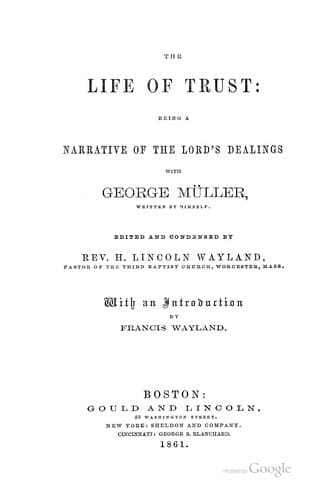
The Life of Trust: Being a Narrative of the Lord's Dealings With George MüllerMüller, George
Religion
The Life of Trust: Being a Narrative of the Lord's Dealings With George Müller
Müller, George
Orphanages -- Great Britain; Prayer
This second point, then, Why do I carry on this business? Why am I
engaged in this trade or profession? ought first to be settled in the
fear of God, and according to the revealed will of God; and if we cannot
say, in honesty of heart, I do carry on my business, I am engaged in my
trade, or art, or profession, as a servant of Jesus Christ, whose I am,
because he has bought me with his precious blood, and he has commanded
me to work, and therefore I work,--I say, if we cannot say this in
honesty of heart, but must confess that we work on account of lower
motives, such as that we may earn our bread, or on account of still
lower motives, and such as are altogether unbecoming a child of God, who
is not of the world, but of God, such as to obtain a certain sum of
money in order to be able to live on the interest without having to
work, or to provide something for old age, or to obtain a certain amount
of property without intending to give up business;--if these are our
motives for being engaged in our calling, I say, can we be surprised
that we meet with great difficulties in our business, and that the Lord
in his abounding love to us, his erring children, does not allow us to
succeed? But suppose this second point is scripturally settled, and we
can honestly say that, because we are servants of Jesus Christ, we are
occupied as we are; we have further to consider,--
3. Whether we carry on our business, or are engaged in our trade, art,
or profession, _as stewards_ of the Lord. To the child of God it ought
not to be enough that he is in a calling in which he can abide with God,
nor that he is engaged in his calling because it is the will of his Lord
and Master that he should work, but he should consider himself in his
trade, business, art, or profession, only as the _steward_ of the Lord
with reference to his income. The child of God has been bought with the
precious blood of the Lord Jesus, and is altogether his property, with
all that he possesses, his bodily strength, his mental strength, his
ability of every kind, his trade, business, art, or profession, his
property, etc.; for it is written, "Ye are not your own; for ye are
bought with a price." 1 Cor. vi. 19, 20. The proceeds of our calling are
therefore not our own in the sense of using them as our natural heart
wishes us to do, whether to spend them on the gratification of our
pride, or our love of pleasure, or sensual indulgences, or to lay by the
money for ourselves or our children, or use it in any way as we
_naturally_ like, but we have to stand before our Lord and Master, whose
_stewards_ we are, to seek to ascertain his will, how he will have us
use the proceeds of our calling.
Public-domain text, read in full here on John Shaqi.
Reviews
Reviews
No reviews yet
Be the first to share your thoughts on this work.
Elsewhere in the archive
Join the Discussion
Join the discussion
Sign in to leave a comment or review.
Sign InorCreate an account