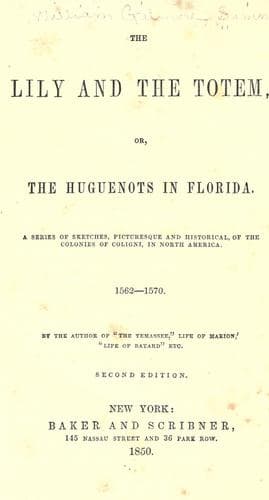
The Lily and the Totem; or, The Huguenots in FloridaSimms, William Gilmore
History
The Lily and the Totem; or, The Huguenots in Florida
Simms, William Gilmore
Florida -- History -- Huguenot colony, 1562-1565 -- Fiction
We need not waste time upon the preliminaries of the contest. Enough
that, about ten o'clock at night, we find the rival players placed at
the table; the opposing pieces arrayed in proper order of battle, with
Le Moyne and Challus, looking on with faces filled with expectation and
curiosity. The face of Alphonse D'Erlach might also be perceptible, in a
momentary glance over the shoulders of one or other of the parties; but
his movements were capricious, and, passing frequently between his own
and the chamber of Laudonniere, he only looked at intervals upon the
progress of the game. Unhappily, the details of this great match, the
several moves, and the final position of the remaining pieces, at the
end of the contest, have not been preserved to us, though it is not
improbable that the painter Le Moyne, as well as Challus, took notes of
it. Enough, that Laudonniere put forth all his skill, exercised all his
caution, played as slowly and heedfully as possible, and was----but we
anticipate. Marchand, on the contrary, seemed never more indifferent. He
scarcely seemed to look at the board--played promptly, even rapidly, and
wore one of those cool, almost contemptuous, countenances which seemed
to say, "I know myself and my enemy, and feel sure that I have no
cause of fear." That his opinions were of this character is beyond all
question; but, though his countenance expressed as much, Laudonniere
reassured himself with the reflection that Marchand was well understood
to be one of those fortunate persons who know admirably how to disguise
their real emotions, however deeply they may be excited or anxious.
Laudonniere's self-esteem was not deficient, in the absence of better
virtues. He had his vanity at chess, and the game was so played, that
the issue continued doubtful, except possibly to one of the spectators,
almost to the last moment. Leaving the parties at the board, silent and
studious, let us turn to the counsels of the conspirators, whom we must
not suppose to be idle all this time.
They had assembled--half a dozen of them at least--and were in close
conference at the quarters of La Roquette, at the opposite extremity of
the fortress. They were all excited to the highest pitch of expectation.
The hour was drawing nigh for the attempt, and all eyes were turned upon
Le Genré.
"It is half past eleven," he exclaimed, "and the thing is to be done.
But what is to be done, if those men whom we hold doubtful should take
courage, and, in the moment of uproar take arms against us? We have
made no preparations for this event. Now, this firing the train from my
lodgings is but the work of a boy. It may be done by any body. It is
more fitting that, with six or eight select men, well armed, I should be
in reserve, ready to encounter resistance should there be any after the
explosion."
Villemain, a youth of twenty-two, a dark, sinister-looking person,
slight and short, promptly volunteered to fire the train. His offer was
at once accepted.
Public-domain text, read in full here on John Shaqi.
Reviews
Reviews
No reviews yet
Be the first to share your thoughts on this work.
Elsewhere in the archive
Join the Discussion
Join the discussion
Sign in to leave a comment or review.
Sign InorCreate an account