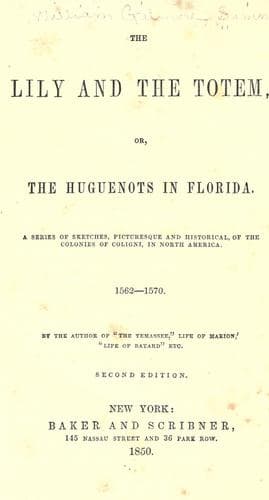
The Lily and the Totem; or, The Huguenots in FloridaSimms, William Gilmore
History
The Lily and the Totem; or, The Huguenots in Florida
Simms, William Gilmore
Florida -- History -- Huguenot colony, 1562-1565 -- Fiction
Of this King Calos, the narrative of our Spaniards goes farther, passing
finally into the province of the miraculous. He is described as a prince
held in special reverence by his subjects;--not simply for his valor
as a soldier, or his wisdom as a ruler, but his wondrous powers as a
magician. He seems to have combined the civil and the religious powers
of the nation--to have been priest and prophet as well as Governor. The
government of his country, like that of simple nations generally, was
theocratic and patriarchal. His people were taught to believe that it
was through his spells and incantations, that the earth brought forth
her fruits. He resorted to various arts to perpetuate this faith, and
various cruelties to subdue and punish that spirit of inquiry which
might test too closely the propriety of his spiritual claims. Twice a
year he retired from the sight of all his subjects, two or three of his
friends alone excepted, and was supposed, at this season, to be busy
with his mighty sorceries. Woe to the unlucky wretch who, whether
purposely or by accident, intruded upon his mysteries. The dwelling to
which he had resort was tabooed on every hand; and death, with the most
fearful penalties, stood warningly at all the avenues by which it was
approached. Each year a prisoner was sacrificed to the savage god he
served; and this prisoner, so long as Barbu had been a captive, had been
a Spaniard always--the supply being sufficient, from the frequency of
wrecks upon the coast, by which an adequate number of captives was
always to be had. The dominions of Calos are described as lying along a
river, beyond the cape of Florida, forty or fifty leagues towards the
southwest; while those of Onathaqua were nearer to La Caroline, on the
northern side of the cape, "in a place which we call in the chart,
Cannaverel, which is in 28 degrees."
Public-domain text, read in full here on John Shaqi.
Reviews
Reviews
No reviews yet
Be the first to share your thoughts on this work.
Elsewhere in the archive
Join the Discussion
Join the discussion
Sign in to leave a comment or review.
Sign InorCreate an account