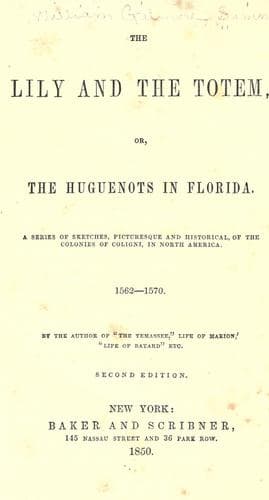
The Lily and the Totem; or, The Huguenots in FloridaSimms, William Gilmore
History
The Lily and the Totem; or, The Huguenots in Florida
Simms, William Gilmore
Florida -- History -- Huguenot colony, 1562-1565 -- Fiction
"Thus was I separated from my only surviving kinsman; and neither of us
could tell the fate which was in waiting for the other. Verily, then did
I look to find the worst. I no longer had a hope. It is my shame, as a
Christian, that, in that desolate moment, I ceased to have a fear. I
not only expected death, but I longed for it. I could have kissed the
friendly hand that had driven the heavy stone hatchet of the savage into
my brain. But, the Blessed Mother of God be praised, I thought not, in
my despair, to do violence to my own self. That sin was spared me among
my many sins, in that hour of despondency and woe; and all my crime
consisted in the criminal indifference which made me too little heedful
to preserve life. But this indifference lasted not long. I was the
captive of the king of Calos himself. Nine others were kept by him
including me, and among these was the cruel tyrant upon whose head lay
the blood of so many of the wretched people of Mexico, Don Juan de Mores
y Silva. He was the tyrant no longer. All his strength and courage had
departed in his afflictions; and in the hour of our despair and terror,
he was feebler than the meanest among us; feebler of soul than the girl
whose heart beats with the dread that she cannot name, fearfully, as
that of the little bird which you cover with your hand. We loathed him
the worse for his miserable fear; and it made us all more resolute in
courage to see one so cast down with his terrors, whom we had seen of
late so insolent in his triumphs.
"When the lots were determined, the king of Calos drew nigh to examine
us more heedfully. He had not before regarded us with any consideration.
Verily, he was a noble savage to the eye. His person was tall, like one
of the sons of Anak, and his carriage was that of a great warrior, born
a prince, to whom it was natural equally to conquer and to rule. Rich
were the garments of flowing cotton which he wore loosely, like a robe,
mostly white, but with broad stains of crimson about the skirts and
shoulders.
Public-domain text, read in full here on John Shaqi.
Reviews
Reviews
No reviews yet
Be the first to share your thoughts on this work.
Elsewhere in the archive
Join the Discussion
Join the discussion
Sign in to leave a comment or review.
Sign InorCreate an account