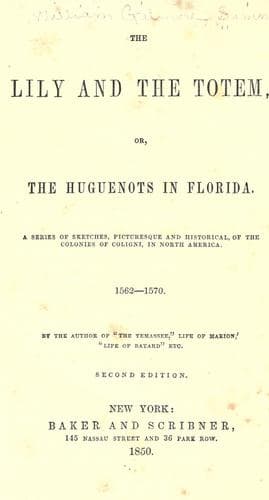
The Lily and the Totem; or, The Huguenots in FloridaSimms, William Gilmore
History
The Lily and the Totem; or, The Huguenots in Florida
Simms, William Gilmore
Florida -- History -- Huguenot colony, 1562-1565 -- Fiction
The Paracoussi Olata Utina, now made an effort to obtain his liberty.
The hopes of the Frenchmen, in respect to his ransom, had failed.
His people had shown a stubbornness, which, to do the Indian monarch
justice, had not been greater than his own. He saw the poverty and
distress which prevailed among his captors, in spite of all their
attempts at concealment. He saw that the lean and hungry famine was
still preying upon their hearts. He said to Laudonniere--
"Of what avail is it to you or to me, that you hold me here a captive?
Take me to my people. The maize is probably ripened in my fields. One of
these shall be set aside for your use wholly, with all its store of corn
and beans, if you will set me free in my own country."
Laudonniere consulted with his chief men. They concurred in granting the
petition of the Paracoussi. The two barks were accordingly fitted out,
and, with a select detachment, Laudonniere proceeded with his captive
to a place called Patica, some eight or nine leagues distant from the
village of Utina. The red-men fled at their approach, seeking cover in
the forests, though their king, himself, cried to them to await his
coming. To pursue them was impossible. To trust the king out of their
possession, without any equivalent, was impolitic. Another plan was
pursued. One of the sons of the Paracoussi, a mere boy, had been taken
with his father. It was now determined to dismiss this boy to the
village, accompanied by one of the Frenchmen, who had been thither
before, and who knew the character and condition of the country. His
instructions were to restore the boy to his mother and his kindred, and
to say that his father should be delivered also, if an adequate supply
of provisions was brought to the vessel. The ancient chronicle, briefly,
but very touchingly, describes the welcome which was given to the
enfranchised child. All were delighted to behold him, the humblest
making as much of him as if he had been the nearest kindred, and each
man thinking himself never so happy as when permitted to touch him with
his hand. The wife of Utina, with her father, came to the barks of the
Frenchmen, bringing bread for the present wants of the company; but
the policy of the Indians did not suffer the pleadings of the woman to
prevail. The parties could not agree about the terms of ransom; the
red-men, meanwhile, practised all their arts to delay the departure of
the vessels. It was discovered that they were busy with their forest
strategy, seeking rather to entrap the captain of the French, than
to bargain for the recovery of their own chieftain. Laudonniere was
compelled finally to return with his prisoner to La Caroline, as hungry
as ever, and with no hopes of the future.
Public-domain text, read in full here on John Shaqi.
Reviews
Reviews
No reviews yet
Be the first to share your thoughts on this work.
Elsewhere in the archive
Join the Discussion
Join the discussion
Sign in to leave a comment or review.
Sign InorCreate an account