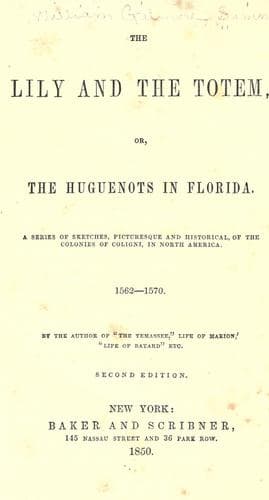
The Lily and the Totem; or, The Huguenots in FloridaSimms, William Gilmore
History
The Lily and the Totem; or, The Huguenots in Florida
Simms, William Gilmore
Florida -- History -- Huguenot colony, 1562-1565 -- Fiction
or purposes, impaired the dream of youth and rapture which prevailed
everywhere in the hearts of the people. Gay assemblages were ever to be
found among the villages in the forests; singing their own delights and
imploring the stranger to be happy also. They had a thousand songs and
sports of youth and pleasure, which made life a perpetual round of ever
freshening felicity. Innocent as wild, no eye of the ascetic could
rebuke enjoyments which violated no cherished laws of experience and
thought, and their glad and sprightly dances, in the deep shadows of the
wood, to the lively clatter of Indian gourds and tambourines, were quite
as significant of harmless fancies as of thoughtless lives. Happy was
the lonely voyager, speeding along the coast, in his frail canoe, when,
suddenly darting out from the forests of Iracana, a slight but lovely
creature, with flowing tunic of white cotton, stood upon the head land,
waving her branch of palm or myrtle, entreating his approach, and
imploring him to delay his journey, while he shared in the sweet
festivities of love and youth, for a season, upon the shore,--crying
with a sweet chant,--
"Love you me not, oh, lonely voyager--love you me not? Lo! am I not
lovely; I who serve the beautiful queen of Iracana? will you not come to
me, for a while!--come, hide the canoe among the reeds, along the shore,
and make merry with the damsels of Iracana. I give to thee the palm and
the myrtle, in token of a welcome of peace and love. Come hither, oh!
lonely voyager, and be happy for a season!"
And seldom were these persuasions unavailing. The lonely voyager was
commonly won, as was he who, sailing by Scylla and Charybdis, refused to
seal his ears with wax against the song of the Syren. But our charmers,
along the banks of the Satilla, entreated to no evil, laid no snares for
the unwary, meditating their destruction. They sought only to share the
pleasures which they themselves enjoyed. The benevolence of that love
which holds its treasure as of little value, unless its delights may be
bestowed on others, was the distinguishing moral in the Indian Eden of
Iracana; and he who came with love, never departed without a sorrow,
such as made him linger as he went, and soon return, when this were
possible, to a region, which, among our Floridians, realized that period
of the Classic Fable, which has always been designated, par excellence,
as the "age of gold."
Public-domain text, read in full here on John Shaqi.
Reviews
Reviews
No reviews yet
Be the first to share your thoughts on this work.
Elsewhere in the archive
Join the Discussion
Join the discussion
Sign in to leave a comment or review.
Sign InorCreate an account