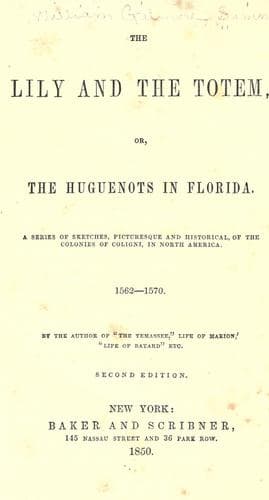
The Lily and the Totem; or, The Huguenots in FloridaSimms, William Gilmore
History
The Lily and the Totem; or, The Huguenots in Florida
Simms, William Gilmore
Florida -- History -- Huguenot colony, 1562-1565 -- Fiction
The robes of the Queen herself were ample. The skirts of her dress fell
below her knees, a thing very uncommon with the women of Florida. Over
this, she wore a tunic of crimson, which descended below her hips. A
slight cincture embraced, without confining, her waist. Long strings
of sea-shell, of the smallest size, but of colors and tints the most
various and delicate, drooped across her shoulders, and were strung, in
loops and droplets, to the skirts of her dress and her symar. Similar
strings encircled her head, from which the hair hung free behind, almost
to the ground, a raven-like stream, of the deepest and most glossy
sable. Her form was equally stately and graceful--her carriage betrayed
a freedom, which was at once native and the fruit of habitual exercise.
Nothing could have been more gracious than the sweetness of her welcome;
nothing more utterly unshadowed than the sunshine which beamed in her
countenance. She led her guests among the crowd, and soon released La
Vasseur to one of the loveliest girls who came about her. Alphonse
D'Erlach she kept to herself. She was evidently struck with the singular
union of delicacy and youth with sagacity and character, which declared
itself in his features and deportment.
Very soon were all the parties engaged in the mazes of the Indian dance
of Iracana,--a movement which, unlike the waltz of the Spaniards, less
stately perhaps, and less imposing--yet requires all its flexibility and
freedom, and possesses all its seductive and voluptuous attractions.
Half the night was consumed with dancing; then gay parties could be seen
gliding into canoes and darting across the stream to other villages and
places of abode. Anon, might be perceived a silent couple gliding
away to sacred thickets; and with the sound of a mighty conch, which
strangely broke the silence of the forest, the Queen herself retired
with her attendants, having first assigned to certain of her chiefs the
task of providing for the Frenchmen. Of these she had already shown
herself sufficiently heedful and solicitous. Not sparing of her regards
to La Vasseur, she had particularly devoted herself to D'Erlach, and,
while they danced together, if the truth could be spoken of her simple
heart, great had been its pleasure at those moments, when the spirit of
the dance required that she should yield herself to his grasp, and die
away languidly in his embrace.
"Ah! handsome Frenchman," she said to her companion,--"You please me so
much."
Public-domain text, read in full here on John Shaqi.
Reviews
Reviews
No reviews yet
Be the first to share your thoughts on this work.
Elsewhere in the archive
Join the Discussion
Join the discussion
Sign in to leave a comment or review.
Sign InorCreate an account