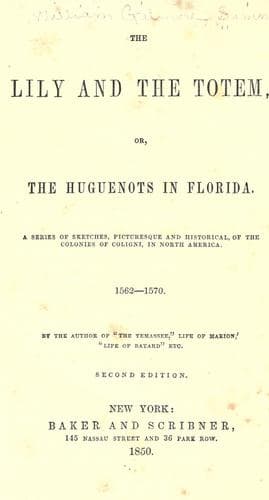
The Lily and the Totem; or, The Huguenots in FloridaSimms, William Gilmore
History
The Lily and the Totem; or, The Huguenots in Florida
Simms, William Gilmore
Florida -- History -- Huguenot colony, 1562-1565 -- Fiction
But, we need not pursue these details. The hour of separation had
arrived. Our Frenchmen had brought with them a variety of commodities
grateful to the Indian eye, with which they designed to traffic; but the
bounty of Iracana, which had anticipated all their wants, had asked
for nothing in return. The treasures of the Frenchmen were accordingly
distributed in gifts among the noble men and women of the place. Some of
these Iracana condescended to take from the hands of Aphon. Her tears
fell upon his offering. She gave him in return two small mats, woven of
the finer straws of the country, with her own hands--wrought, indeed,
while D'Erlach sat beside her in the shade of a great oak by the river
bank--and "so artificially wrought," in the language of the chronicle,
"as it was impossible to make it better." The poor Queen had few words--
"You will come to me, _Aphon_--you will? you will? I too much want you!
Come soon, _Aphon_. Iracana will dance never no more till _Aphon_ be
come."
"_Aphon_" felt, at that moment, that he could come without sorrow. He
promised that he would. Perhaps he meant to keep his promise; but we
shall see. The word was given to be aboard, and the trumpet rang,
recalling the soldier who still lingered in the forest shadows, with
some dusky damsel for companion. All were at length assembled, and with
a last squeeze of her hand, D'Erlach took leave of his sorrowful queen.
She turned away into the woods, but soon came forth again, unable to
deny herself another last look.
But the Frenchmen were delayed. One of their men was missing. Where was
Louis Bourdon? There was no answer to his name. The boats were searched,
the banks of the river, the neighboring woods, the fields, the Indian
village, and all in vain. The Frenchmen observed that the natives
exhibited no eagerness in the search. They saw that many faces were
clothed with smiles, when their efforts resulted fruitlessly. They could
not suppose that any harm had befallen the absent soldier. They could
not doubt the innocence of that hospitality, which had shown itself so
fond. They conjectured rightly when they supposed that Louis Bourdon, a
mere youth of twenty, had gone off with one of the damsels of Iracana,
whose seductions he had found it impossible to withstand. D'Erlach
spoke to the Queen upon the subject. She gave him no encouragement. She
professed to know nothing, and probably did not, and she would promise
nothing. She unhesitatingly declared her belief that he was in the
forest, with some one that "he so much loved:" but she assured D'Erlach
that to hunt them up would be an impossibility.
"Why you not stay with me, Aphon, as your soldier stay with the woman he
so much love? It is good to stay. Iracana will love you too much more
than other woman. Ah! you love not much the poor Iracana."
"Nay, Iracana, I love you greatly. I will come to you again. I find it
hard to tear myself away. But my people--"
Public-domain text, read in full here on John Shaqi.
Reviews
Reviews
No reviews yet
Be the first to share your thoughts on this work.
Elsewhere in the archive
Join the Discussion
Join the discussion
Sign in to leave a comment or review.
Sign InorCreate an account