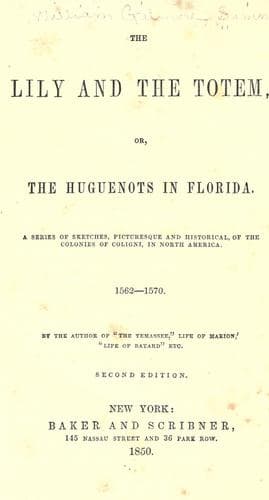
The Lily and the Totem; or, The Huguenots in FloridaSimms, William Gilmore
History
The Lily and the Totem; or, The Huguenots in Florida
Simms, William Gilmore
Florida -- History -- Huguenot colony, 1562-1565 -- Fiction
Here, we are fortunately in possession of the narrative of Hawkins
himself, and his report of the encounter with our Frenchmen. It affords
a good commentary upon the bad management of Laudonniere, and the
worthless character of his followers; the sturdy Englishmen seeing, at a
glance, where all the evils of the colony lay. He describes their first
settlement as gathered from their own lips; their numbers, the period
they had remained in the country, their frequent want, and the modes
resorted to for escaping famine. His details comprise all the facts
of our history, as already given. Of their discontents and rebels, he
speaks as of a class, "who would not take the paines so much as to fishe
in the river before their doores, but would have all thinges put in
their mouthes. They did rebell against the Captaine, taking away first
his armour, and afterwards imprisoning him, &c." The narrative of
Hawkins gives the subsequent history of the rebels, their piracy,
capture and fate. He mentions one particular, which we do not gather
from Laudonniere, showing the sagacity of the Floridian warriors.
Finding that the Frenchmen, in battle, were protected by their coats of
mail, or escaupil, and the bucklers in familiar use at the time, they
directed their arrows at the faces and the legs of their enemies, which
were the parts in which they were mostly wounded. At the close of this
war, according to our Englishmen, Laudonniere had not forty soldiers
left unhurt. After detailing the supplies accorded to the colonists from
his stores, he adds, "notwithstanding the great want that the Frenchmen
had, the ground doth yield victuals sufficient, if they would have taken
paines to get the same; _but they being souldiers, desired to live by
the sweat of other men's browes_." Here speaks the jealous scorn of the
sailor. "The ground yieldeth naturally great store of grapes, for in the
time the Frenchmen were there they made twenty hogsheads of wine." Our
poor Huguenots could seek gold and manufacture wine, but could not raise
provisions. They were of too haughty a stomach to toil for any but the
luxuries of life. "Also," says Hawkins, "it (the earth) yieldeth roots
passing good, deere marvellous store, with divers other beastes and
fowle serviceable to man. These be things wherewith a man may live,
having corne or maize wherewith to make bread, for maize maketh good
savory bread, and cakes as fine as flowre; also, it maketh good meale,
beaten and sodden with water, and nourishable, which the Frenchmen did
use to drink of in the morning, and it assuageth their thirst, so that
they have no need to drink all the day after. And this maize was the
greatest lack they had, because they had no labourers to sowe the same;
and therefore, to them that should inhabit the land, it were requisite
to have labourers to till and sowe the ground; for they, having victuals
of their owne, whereby they neither spoil nor rob the inhabitants, may
Public-domain text, read in full here on John Shaqi.
Reviews
Reviews
No reviews yet
Be the first to share your thoughts on this work.
Elsewhere in the archive
Join the Discussion
Join the discussion
Sign in to leave a comment or review.
Sign InorCreate an account