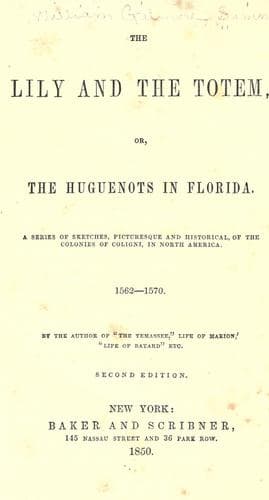
The Lily and the Totem; or, The Huguenots in FloridaSimms, William Gilmore
History
The Lily and the Totem; or, The Huguenots in Florida
Simms, William Gilmore
Florida -- History -- Huguenot colony, 1562-1565 -- Fiction
But Laudonniere had his argument also, and it was not without its
significance. He opposed the scheme of Ribault entirely; representing
the defenceless condition of the fortress, and the danger to the fleet
at sea, and upon the coast, during a season proverbially distinguished
by storms and hurricanes. His counsel was approved of by other captains;
but Ribault, an old soldier and sea captain, was too eager to engage
the enemy to listen to arguments that seemed to partake of the
pusillanimous. It was very evident that he did not regard Laudonniere
as the best of advisers in the work of war. He took his own head
accordingly, and commanded all soldiers that belonged to his command to
go on board their vessels. Not satisfied with this force, he lessened
the strength of the garrison by taking a detachment of its best men,
leaving few to keep the post but the invalids, who, like Laudonniere,
were suffering, or but just recovering, from the diseases of the climate
in midsummer. Laudonniere expostulated, but in vain, against this
appropriation of his garrison. On the eighth of September, Ribault left
the roadstead in pursuit of the Spaniards, and Laudonniere never beheld
him again. That very day the skies were swallowed up in tempests. Such
tempests were never beheld before upon the coast. The storms prevailed
for several days, at the end of which time, apprehending the worst,
Laudonniere mustered his command, and proceeded to put the fortress in
the best possible condition of defence. To repair the portions of the
wall which had been thrown down, to restore the palisades stretching
from the fortress to the river, was a work of equal necessity and
difficulty; which, with all the diligence of the Frenchmen, advanced
slowly, in consequence of the violence and long continuance of the
stormy weather. The whole force left in the garrison consisted of but
eighty-six persons supposed to be capable of bearing arms. Of their
doubtful efficiency we may boldly infer from these facts. Several of
them were mere boys, with sinews yet unhardened into manhood. Some were
old men, completely _hors de combat_ from the general exhaustion of
their energies; many were still suffering from green wounds, got in
the war with Olata Utina, and others again were wholly unprovided with
weapons. Relying upon the assumption that he should find his enemy at
sea and in force, Ribault had stripped the garrison of its real manhood.
His vessels being better sailers than those of the Spaniards, he took
for granted that he should be able to interpose, at any moment, for the
safety of La Caroline, should any demonstration be made against it.
This was assuming quite too much. It allowed nothing for the caprices of
wind and wave; for the sudden rising of gales and tempests; and accorded
too little to the cool prudence, and calculating generalship of Pedro
Melendez, one of the most shrewd, circumspect and successful of the
Spanish generals of the period: nor, waiving these considerations, was
Public-domain text, read in full here on John Shaqi.
Reviews
Reviews
No reviews yet
Be the first to share your thoughts on this work.
Elsewhere in the archive
Join the Discussion
Join the discussion
Sign in to leave a comment or review.
Sign InorCreate an account