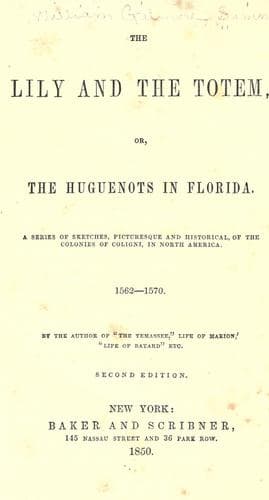
The Lily and the Totem; or, The Huguenots in FloridaSimms, William Gilmore
History
The Lily and the Totem; or, The Huguenots in Florida
Simms, William Gilmore
Florida -- History -- Huguenot colony, 1562-1565 -- Fiction
great city which lay among the mountains. This was described to them, in
language often heard before, as containing a wealth of gold, and other
treasures in the shape of precious gems, which, assuming the truth
of the description given by the red-men, our Frenchmen assumed to be
nothing less than diamonds, rubies and crystals. But they were told that
this country was in possession of a very powerful people, fierce and
warlike, who were very jealous of the appearance of strangers. The city
of Grand Copal was described as very populous and rich, a walled town,
which it would be difficult to penetrate.
These descriptions contributed greatly to warm the imaginations of our
Frenchmen, but as the several informants differed in regard to the
direction in which this great city lay, it so happened that parties
began to be formed in respect to the route which should be pursued.
Opinion was nearly equally divided among them. Alphonse D'Erlach was for
pursuing a more easterly course than was desired by some ten or more of
the party. He was influenced by information previously derived from the
Indians, when he went into the territories of Olata Utina, and beyond.
But the more recent testimony was in favor of the west, and this he
was disposed to disregard. For a time, the discussion led to nothing
decisive. His authority was still deferred to and the course continued
upon which he had begun. But as the winter began to press more severely
upon the company, and as their usual supplies of game began to diminish
from the moment that they left the lakes, and great swampy river margin
of the flat country, from that moment, as if justified by suffering, the
Frenchmen lessened in their deference to a leader who was at once so
youthful and so imperative. Alphonse D'Erlach beheld these symptoms with
apprehension and misgiving. He well knew how frail was the tenure by
which he held his authority, from the moment that self-esteem began to
be active in the formation of opinion. He felt that a power for coercion
was wanting to his authority, and resorted to all those politic arts by
which wise men maintain a sway without asserting it. He would say to
them:
"My comrades, there are but twenty-two of us in a world of savages.
Hitherto, for more than thirty days, we have traversed the wildernesses
in safety. This is solely due to the fact that we have suffered no
differences to prevail among us. If you feel that I have counselled and
led you in safety, you may also admit that I have led you rightly; for
safety has been our first object. We are as fresh and vigorous now, as
when we left the dreary plains of Cannaverel. Not one has perished.
We have not suffered from want of food, though frequently delayed in
obtaining it. Methinks, that you have no reason to complain of me. But
if there be dissatisfaction with my authority, choose another leader.
Him will I obey with good will; but do not suffer yourselves to
disagree, lest ye separate, and all parties perish."
Public-domain text, read in full here on John Shaqi.
Reviews
Reviews
No reviews yet
Be the first to share your thoughts on this work.
Elsewhere in the archive
Join the Discussion
Join the discussion
Sign in to leave a comment or review.
Sign InorCreate an account