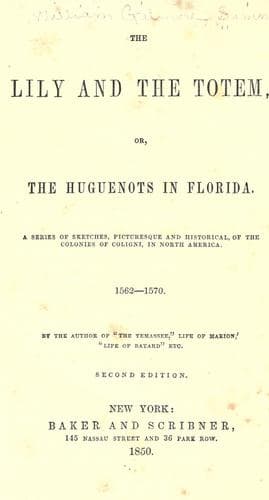
The Lily and the Totem; or, The Huguenots in FloridaSimms, William Gilmore
History
The Lily and the Totem; or, The Huguenots in Florida
Simms, William Gilmore
Florida -- History -- Huguenot colony, 1562-1565 -- Fiction
which guarded their slumbers from the assaults of wolf and panther; the
howls of the one, and the screams of the other, sounding ever and anon
within their ears, from the bald rocks which overhung the camp. On the
morning of the third day the fugitives were found, close together, and
stiffened in death. They had evidently perished from the cold.
Very sadly did the D'Erlachs return with their one companion to the camp
where they had left their comrades. But their gloom and grief were not
to suffer diminution. What was their horror to find the spot wholly
deserted. The ashes were cold where they had made their fires: the
probability was that the place had been fully a day and night abandoned.
No traces of the Frenchmen were left--not a clue afforded to their
brethren of what had taken place. Alphonse D'Erlach, however, discovered
the track of an Indian moccasin in the ashes, but he carefully
obliterated it before it was beheld by his companions. It was apparent
to him that his people had suffered themselves to be surprised; but
whether they had been butchered or led into captivity was beyond his
conjecture. His hope that they still lived was based upon the absence of
all proofs of struggle or of sacrifice.
To linger in that spot was impossible; but whither should they direct
their steps.
"We are but three, now, my comrades," said the younger D'Erlach,--"we
must on no account separate. We must sleep and hunt together, and suffer
no persuasions to part us. Let us descend from this inhospitable
mountain, and, crossing the stretch of valley which spreads below,
attempt the heights opposite. We may there find more certain food, and
better protection from these bleak winds."
"Better that we had perished with our comrades, under the knife of
Melendez," was the gloomy speech of the elder D'Erlach.
"It is always soon enough to die," replied the younger. "For shame, my
brother!--it is but death, at the worst, which awaits us. Let us on!"
And he led the way down the rugged heights, the others following
passively and in moody silence.
Public-domain text, read in full here on John Shaqi.
Reviews
Reviews
No reviews yet
Be the first to share your thoughts on this work.
Elsewhere in the archive
Join the Discussion
Join the discussion
Sign in to leave a comment or review.
Sign InorCreate an account