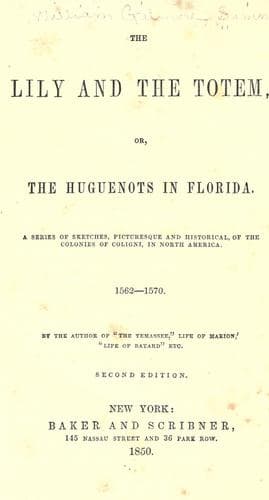
The Lily and the Totem; or, The Huguenots in FloridaSimms, William Gilmore
History
The Lily and the Totem; or, The Huguenots in Florida
Simms, William Gilmore
Florida -- History -- Huguenot colony, 1562-1565 -- Fiction
that had almost ceased to breathe, answered the convulsive motion which
indicated the last struggle of their beloved comrade.[14] Then it was
that they began to feel that they could have died for him, and might
have saved him. But it was now too late; and prudence timely interposed
to prevent a rash explosion. The armed myrmidons of Albert were about
them. He, himself, in complete armor, with his satellite, Pierre Renaud,
also fully armed, standing beside him; and it was evident that every
preparation had been made to quell insubordination, and punish the
refractory with as sharp and sudden a judgment as that which had just
descended upon their comrade.
[14] Says Charlevoix:--"Il pendit lui-même un soldat, qui n'avoit
point merité la mort, il en dégrada un autre des armes avec aussi peu
de justice, puis il l'exila, et l'on crut que son dessein étoit de le
laisser mourir de faim et de misere, etc." But we must not anticipate
the revelations of the text.
The poor Monaletta, crouching in the cover of the woods, recovered from
her stupor in the cool air of the morning, but it was sunset before she
could regain the necessary strength to move. Then it was, that, with the
natural tendency of a loving heart, curious only about the fate of him
for whom alone her heart desired life, she bent her steps towards that
cruel fortress which had been the source of so much misery to both. Very
feeble and slow was her progress, but it was still too rapid; it brought
her too soon to a knowledge of that final blow which fell, with worse
terrors than the scourge, upon the soul. She arrived in season to behold
the form of the unfortunate Guernache, abandoned by all, and totally
lifeless, waving in the wind from the branches of a perished oak,
directly in front of the fortress. The deepest sorrows of the heart are
those which are born dumb. There are some woes which the lip can never
speak, nor the pen describe. There are some agonies over which we draw
the veil without daring to look upon them, lest we freeze to stone in
the terrible inspection. There is no record of that grief which seized
upon the heart of the poor Indian woman, Monaletta, as she gazed upon
the beloved but unconscious form of her husband. She approached it not,
though watching it from sunset till the gray twilight lapsed away into
the denser shadows of the night. But, with the dawn of day, when the
Frenchmen looked forth from the fortress for the body of their comrade,
it had disappeared. They searched for it in vain. From that day
Monaletta disappeared also. She was neither to be found in the
neighboring woods, nor among the people of her kindred. But, long
afterwards they told, with shuddering and apprehension, of a voice
upon the midnight air, which resembled that of their murdered comrade,
followed always by the piercing shriek of a woman, which reminded them
of the dreadful utterance of the Indian woman, when first smitten upon
the shoulders by the lash of the ruffian.
Public-domain text, read in full here on John Shaqi.
Reviews
Reviews
No reviews yet
Be the first to share your thoughts on this work.
Elsewhere in the archive
Join the Discussion
Join the discussion
Sign in to leave a comment or review.
Sign InorCreate an account