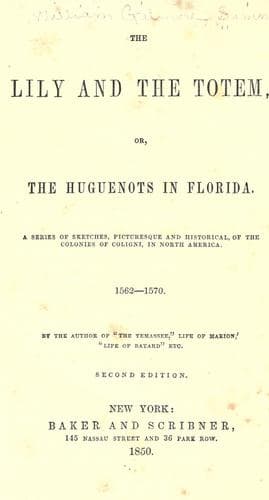
The Lily and the Totem; or, The Huguenots in FloridaSimms, William Gilmore
History
The Lily and the Totem; or, The Huguenots in Florida
Simms, William Gilmore
Florida -- History -- Huguenot colony, 1562-1565 -- Fiction
Everything succeeded to the wishes of the conspirators. Albert, who
was passionately fond of the chase, was easily persuaded by the
representations of Barré and his comrades. The pinnace was fitted out
at an early hour, and, attended by the two conspirators, and some half
dozen other persons, the greater number of whom were supposed to be
as hostile to the tyrant as themselves, the Captain set forth, little
dreaming that he should be the hunted instead of the hunter. Pierre
Renaud, by whom he was also accompanied, was the only person of the
party upon whom he could rely. But neither his creature nor himself had
the slightest apprehension of the danger. The jealousies of the despot
seemed for the moment entirely at rest, and, as if in the exercise of a
pleasant novelty, Albert threw aside all the terrors of his authority.
He could jest when the fit was on him. He, too, had his moments of play;
a sort of feline faculty, in the exercise of which the cat and the tiger
seem positively amiable. His jests were echoed by his men, and their
laughter gratified him. But there was one exception to the general
mirth, which arrested his attention. Nicholas Barré alone preserved a
stern, unbroken composure, which the gay humor of his superior failed
entirely to overcome. Nothing so much vexes superiority as that it
should condescend in vain; and the silence and coldness of Barré, and
the utter insensibility with which he heard the good things of his
captain, and which occasioned the ready laughter of all the rest,
finally extorted a comment from Albert, which gave full utterance to
his spleen.
"By my life, Lieutenant Barré,"--such was the rank of this
conspirator--"but that I know thee better, I should hold thee to be one
of those unhappy wretches to whom all merriment is a hateful thing--to
whom a clever jest gives offence only, and whom a cheerful laugh sends
off sullenly to bed. Pray, if it be not too serious a humor, tell us the
cause of thy present dullness."
"Verily, Captain Albert," replied the person addressed, fixing his eyes
steadily upon him, and speaking in the most deliberate accents, "I was
thinking of the deer that we shall strike to-day. Doubtless, he is even
now making as merry as thyself among his comrades--little dreaming that
the hunter hath his thoughts already fixed upon the choice morsels of
his flanks, which, a few hours hence, shall be smoking above the fire.
Truly, are we but little wiser than the thoughtless deer. The merriest
of us may be struck as soon. The man hath as few securities from the
morrow as the beast that runs."
Public-domain text, read in full here on John Shaqi.
Reviews
Reviews
No reviews yet
Be the first to share your thoughts on this work.
Elsewhere in the archive
Join the Discussion
Join the discussion
Sign in to leave a comment or review.
Sign InorCreate an account