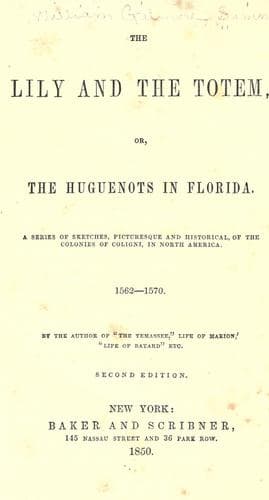
The Lily and the Totem; or, The Huguenots in FloridaSimms, William Gilmore
History
The Lily and the Totem; or, The Huguenots in Florida
Simms, William Gilmore
Florida -- History -- Huguenot colony, 1562-1565 -- Fiction
"When they (the conspirators) were come home againe, they assembled
themselves together to choose one to be Governor over them." In this
selection there was no difficulty. Jealousies and dissensions had ceased
to exist, and the choice naturally fell upon Nicholas Barré,[15] whose
former position, as Lieutenant under Albert, and whose recent connection
with the party by which he was slain, had naturally given him a large
influence among the colonists. He was equal to his new duties. He "knewe
so well to quite himself of this charge that all rancour and dissention
ceased among them, and they lived peaceably one with another." But,
though harmony was restored among them, it was a harmony without hope.
They had been abandoned by their countrymen. The supplies which Ribault
had promised them had utterly failed. They had never, indeed, been
levied. Ribault returned to France only to find it convulsed with a
renewal of the civil war, under the auspices of that incarnate mischief,
Catherine de Medicis, and her fatherless and cruel son, in whose name
she swayed the country to its ruin. Coligny, the father of the colony,
had enough to do in fighting the battles of the Huguenots at home.
He could do nothing for those whom he had sent abroad. The peace of
Longjumean had been of short duration, and there had been really no
remission of hostilities on the part of the Catholics. In the space of
three months more than two thousand of the former fell victims to the
rage of the populace; and, though reluctantly, the Prince of Condé and
Coligny were forced into a resumption of arms for the safety of their
own persons. The immediate necessities of their situation were such
as to defeat their efforts in behalf of the remote settlement at Fort
Charles. They needed all their soldiers and Huguenots in France. Feeling
themselves abandoned--they knew not why--the colonists in Florida ceased
to behold a charm or solace in their solitary realm of refuge. Its
securities were no longer sufficient to compensate for its loneliness.
Better the strife, perhaps, than this unmeaning and unbroken silence.
They were too few for adventure, and the discouragements resulting from
their domestic grievances were enough to paralyze any such spirit. But
for this there had been no lack of the necessary inducements. In their
second voyage to King Ouade, seeking "mil and beans," they had learned
some of the secrets of the country which made their eyes brighten. They
had discovered that there was gold in the land, and that the gold of the
land was good. This prince had freely given them of his treasure. He had
bestowed on them pearls of the native waters, stones of finest chrystal,
and certain specimens of silver ore, which he described, in reply to
their eager inquiries, as having been gathered at the foot of certain
high mountains, the bowels of which contained it in greatest quantity.
These were the mountains of Apalachia, and the truth of Ouade's
Public-domain text, read in full here on John Shaqi.
Reviews
Reviews
No reviews yet
Be the first to share your thoughts on this work.
Elsewhere in the archive
Join the Discussion
Join the discussion
Sign in to leave a comment or review.
Sign InorCreate an account