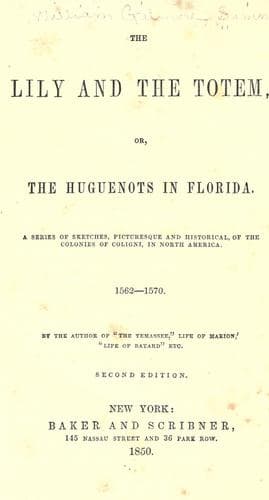
The Lily and the Totem; or, The Huguenots in FloridaSimms, William Gilmore
History
The Lily and the Totem; or, The Huguenots in Florida
Simms, William Gilmore
Florida -- History -- Huguenot colony, 1562-1565 -- Fiction
"Upon the top thereof, we found nothing else but cedars, palms, and bay
trees, of so sovereign odor, that balm smelleth nothing in comparison.
The trees were environed round with vines, bearing grapes in such
quantity that the number would suffice to make the place habitable.
Touching the pleasure of the place, the sea may be seen plain and open
from it; and more than five leagues off, near the river Belle, a man may
behold the meadowes, divided asunder into isles and islets, interlacing
one another. Briefly, the place is so pleasant, that those who are
melancholie would be forced to change their humour."
There is no exaggeration in this. Such is the odor of the shrubs--such
is the picturesqueness of the prospect.
Laudonniere departed with great reluctance from a region so favorable
to health, so beautiful to the eye, and which promised so abundantly of
fruits and mineral treasures. His course lay northwardly, in search of
the colony of Captain Albert. He passes the river of Seine, four leagues
distant from the May, and continues to the mouth of the Somme, some
six leagues further. Here he casts anchor, lands, and is received with
friendly welcome by the Paracoussy, or king of the place, whom he
describes as "one of the tallest and best-proportioned men that may
be found. His wife sate by him, which, besides her Indian beautie,
wherewith she was greatly endued, had so virtuous a countenance and
modest gravitie, that there was not one amongst us but did greatly
commend her. She had in her traine five of her daughters, of so good
grace and so well brought up, that I easily persuaded myself that their
mother was their mistresse."
Here Laudonniere is again presented with specimens of the precious
metals, and here we find him already in consultation with his men,
touching the propriety of abandoning the settlement of Fort Charles, the
fate of which he has heard in his progress from the Indians, for the
more attractive regions of the river May. His arguments for this
preference, may be given in his own language.
"If we passed farther to the north to seeke out Port Royall, it would be
neither very profitable nor convenient,.... although the haven were one
of the fairest of the West Indies: but that, in this case, the question
was not so much of the beautie of the place as of things necessary to
sustaine life. And that for our inhabiting, it was much more needful
for us to plant in places plentiful of victuall, than in goodly havens,
faire, deepe and pleasante to the view. In consideration whereof, I was
of opinion, if it seemed goode unto them, to seate ourselves about the
river of May: seeing also, that, in our first voyage, wee found the same
onely, among all the rest, to abounde in maize and corn; _besides the
golde and silver that was found there; a thing that put me in hope of
some happie discoverie in time to come_."
Public-domain text, read in full here on John Shaqi.
Reviews
Reviews
No reviews yet
Be the first to share your thoughts on this work.
Elsewhere in the archive
Join the Discussion
Join the discussion
Sign in to leave a comment or review.
Sign InorCreate an account