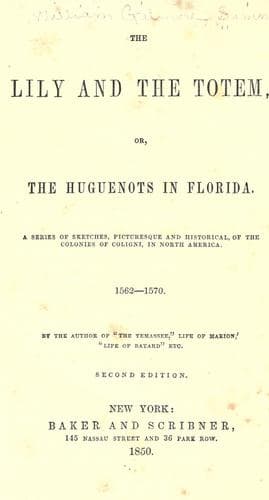
The Lily and the Totem; or, The Huguenots in FloridaSimms, William Gilmore
History
The Lily and the Totem; or, The Huguenots in Florida
Simms, William Gilmore
Florida -- History -- Huguenot colony, 1562-1565 -- Fiction
The necessities of the colony now began to open the eyes of Laudonniere
in respect to the errors of which he had been guilty. He found it
important to discontinue his explorations among the Indian tribes, and
to employ his garrison in domestic labors. They must either work or
starve. Their tasks in the fields were assigned accordingly. This
produced discontent among those who, having for some time, in Europe as
well as recently in the new world, been chiefly employed as soldiers,
regarded labor as degrading, and still flattered themselves with the
more agreeable hope of achieving their fortunes by shorter processes.
Their appetite for the precious metals had been sufficiently enlivened
by the glimpses which had been given them, during their intercourse with
the natives, of the unquestionable treasures of the country. It was
still farther whetted by the influence of two persons of the garrison.
One of these was named La Roquette, of the country of Perigort;
the other was known as Le Genré, a lieutenant, and somewhat in the
confidence of Laudonniere. Le Genré was the bold conspirator. La
Roquette was perhaps quite as potential, though from art rather than
audacity. He pretended to be a great magician, and acquired large
influence over the more ignorant soldiers on the score of his supposed
capacity to read the book of fate. Among his professed discoveries
through this medium, were certain mines of gold and silver, far in the
interior, the wealth of which was such--and he pledged his life upon
it--that, upon a fair division, after awarding the king's portion, each
soldier would receive not less than ten thousand crowns. The arguments
and assurances of La Roquette persuaded Le Genré, among the rest. He
was exceedingly covetous, and sought eagerly all royal roads for the
acquisition of fortune. He was more easily beguiled into conspiracy, in
consequence of the refusal of Laudonniere to give him the command of a
packet returning into France. It was determined to depose and destroy
the latter. Several schemes were tried for this purpose; by poison, by
gunpowder, all of which failed, and resulted in the ruin only of the
conspirators. With this introduction we introduce the reader more
particularly to the parties of our history.
XII.
THE CONSPIRACY OF LE GENRÉ.--Chap. I.
Public-domain text, read in full here on John Shaqi.
Reviews
Reviews
No reviews yet
Be the first to share your thoughts on this work.
Elsewhere in the archive
Join the Discussion
Join the discussion
Sign in to leave a comment or review.
Sign InorCreate an account