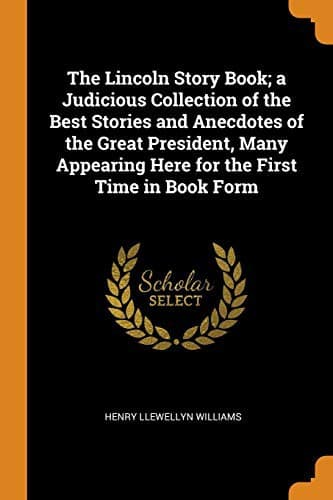
The Lincoln Story Book: A Judicious Collection of the Best Stories and Anecdotes of the Great President, Many Appearing Here for the First Time in Book Form
History
The Lincoln Story Book: A Judicious Collection of the Best Stories and Anecdotes of the Great President, Many Appearing Here for the First Time in Book Form
Lincoln, Abraham, 1809-1865 -- Anecdotes
One evening, when Mr. Hall, astronomer, was working in the Naval
Observatory, Washington, on the great equatorial telescope, he was
startled to have his sanctum invaded by the gaunt, extenuated figure of
the President. He was made welcome, of course, and the varied mechanism
explained to him. As the crowning "treat," he was given a peer through
the celebrated instrument. It was leveled at the moon, or, rather,
arranged to have that orb in its focus at the time. The visitor was
appalled, as well as wondering at the view, and slowly withdrew by the
trap-door. But when the astronomer resumed his observations and
calculations he was interrupted by the same sedate and absorbed caller.
He returned, perplexed, as, on glancing up at the moon with unhindered
vision, he saw it in another position to that presented in the
spy-glass.
Mr. Hall made it clear to him that, as the telescope was pointed, not
at the satellite but at its image in a mirror, he saw its reflection
and consequently the reverse of the face we observe. The President went
away with the satisfaction of a man wanting every novelty demonstrated.
* * * * *
HITCHING TO THE MOON.
Lincoln came to Washington,
To view the situation;
And found the world all upside down,
A rumpus in the nation.
(_Topical song,_ 1860.)
* * * * *
A RED FLAG TO HIM.
A most remarkable prelude to the war was the performance through the
Northern States of the Chicago Zouaves. The name came from the
irregular regiment in the French Algerian service, composed of men
worthy of being drummed out of the regular corps; they dressed like the
Arabs in the small bolero jacket and baggy red, trousers familiar
since. They drilled gymnastically, not to say theatrically. Ellsworth,
a clerk in the Lincoln & Herndon law office, had a martial turn, and
hearing daily in that quasi-political vortex of the impending crisis,
determined to be forearmed in case of the differences coming to blows.
He raised, uniformed _à la Zou-zou_, a score of young men like himself
and proceeded to give exhibitions at home and then in the East. The
writer retains a vivid memory of the odd and fantastic show, which,
however, was regarded as "not war, though magnificent." But Captain
Ellsworth was in earnest. Mustered in with his company, he started the
Zouave movement which led to two or more regiments being formed. His
being the first volunteers at the fore, he claimed the right of the
reconnoitering force sent out in May, against Alexandria, to break up
railroads held by the rebels. Seeing a rebel flag on a hotel top, he
entered the building, and was shot by the landlord in coming down from
cutting it away. He was slain instantly, and the like fate befell the
murderer, the host, from Ellsworth's guard. Apart from four men killed
at Sumter and two in the Baltimore riots, the Chicago Zouave was the
first victim of the rebellion.
Public-domain text, read in full here on John Shaqi.
Reviews
Reviews
No reviews yet
Be the first to share your thoughts on this work.
Elsewhere in the archive
Join the Discussion
Join the discussion
Sign in to leave a comment or review.
Sign InorCreate an account