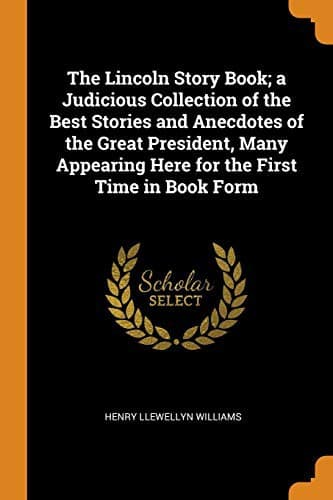
The Lincoln Story Book: A Judicious Collection of the Best Stories and Anecdotes of the Great President, Many Appearing Here for the First Time in Book Form
History
The Lincoln Story Book: A Judicious Collection of the Best Stories and Anecdotes of the Great President, Many Appearing Here for the First Time in Book Form
Lincoln, Abraham, 1809-1865 -- Anecdotes
And beckoning the wondering boy to him with the irresistible attraction
of men who love the young, and are intuitively loved by them, he said:
"Tell your father, rascal, that I forgive him for the sake of your
mother's smile, and your own bright eyes."
This reconciliation on the fall of the sword was a token of the
forgivingness of the North toward the chastened foes.
* * * * *
"CLOSE YOUR EYES!"
The Marquis of Chambrun, a French volunteer, who entered the Lincoln
circle, relates in a more elegant strain the above incident. He states
that Thompson and Sanders were informed upon, and Stanton repeated the
information to the President with a view of having them intercepted.
But the other in his tender voice responded:
"Let us close our eyes, and leave them pass unnoticed."
* * * * *
DON'T JUDGE BY APPEARANCES.
The President's recklessness seems incredible as to going about the
capital, as far as he knew and wished, without escort, but his
"browsing," to use his word, about the perilous front while the
concluding actions were enveloping Petersburg preliminarily to the rush
at Richmond, partake of the nature of a fanatic's daring. This is the
support to the otherwise taxing story told by Doctor J. E. Burriss, of
New York, then a volunteer soldier at the place. He states that
Lincoln, so shabbily dressed as to be taken for a farmer or planter,
was so treated by soldiery before a tobacco-warehouse under guard. They
wanted tobacco, and begged him to allow some to be turned out. He
approached a young lieutenant commanding the post, but the latter was
insolent to the "old Southerner." The latter sent a soldier to General
Grant, who himself rode up, post-haste, at the summons. The soldiers
were given some of the Indian weed, and the donor, turning to the
impertinent officer, who had thought him a converted reb, said:
"Young sir, do not judge by appearances; and for the future treat your
elders with more respect."
* * * * *
"NOTHING CAN TOUCH HIM FURTHER."
Returning to Washington from Richmond, Lincoln read twice to friends on
the journey, from his pocket Shakespeare:
Treason has done his worst; nor steel nor poison,
Malice domestic, foreign levy, nothing,
Can touch him further.
* * * * *
"WENT AND RETURNED!"
The last days of March, 1865, contained the three battles, closing with
that of Five Forks, signalizing the collapse of the Confederacy at
Richmond. The President, at the front, sent the news of victories to
the Cabinet at home. After the battles, the advance of the triumphing
Unionists. On Monday morning Lincoln was enabled to telegraph the
talismanic words so often dreamed of in the last agonizing years of
fluctuating hope:
"_Richmond has fallen_! I am about to enter!"
Secretary Stanton, of the war office, immediately implored: "Do not
peril your life!"
Public-domain text, read in full here on John Shaqi.
Reviews
Reviews
No reviews yet
Be the first to share your thoughts on this work.
Elsewhere in the archive
Join the Discussion
Join the discussion
Sign in to leave a comment or review.
Sign InorCreate an account