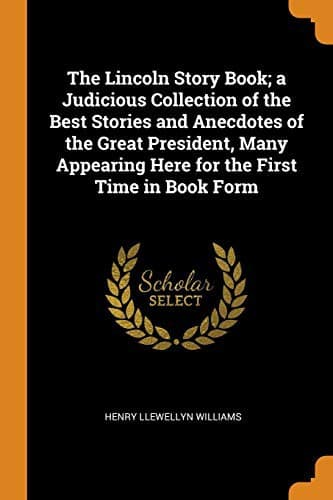
The Lincoln Story Book: A Judicious Collection of the Best Stories and Anecdotes of the Great President, Many Appearing Here for the First Time in Book Form
History
The Lincoln Story Book: A Judicious Collection of the Best Stories and Anecdotes of the Great President, Many Appearing Here for the First Time in Book Form
Lincoln, Abraham, 1809-1865 -- Anecdotes
The dispute as to whether there was a foundation to the supposed plot
to waylay and sequester President-elect Lincoln between Philadelphia
and Washington is notable. From the later light and the letter from
Wilkes Booth to his brother-in-law, Sleeper Clarke, the comedian, no
doubt is left that to kidnap him was a plot dated very early when the
foresighted slave-holders were certain that he was a greater enemy from
consistency than the louder-voiced and openly violent Abolitionists.
While Colonel Lamon doubted, and wished he had not been beguiled into
aiding in the ignominious flight in disguise and secretly by train,
Secretary Seward and General Scott gave it credence. The foreboding had
touched Lincoln before he left his Illinois home. At Springfield his
farewell speech is tinged with shade. At Philadelphia and Harrisburg he
spoke of blood-spilling, and used the word "assassination" at the
former. He took up the matter like a reasoner. Already the detective
brothers, Pinkerton, had an inkling of the doings of the Knights of the
Golden Circle, or some such secret society, designing regicide. So, as
the Concordance is held as a proof from the variance of the witnesses
to scenes, he argued that the story was founded. Otherwise he would not
have heard of the criminal attempt from all sides. That was what made
him yield his dignity to the safety of a person whom he felt was chosen
for the crisis. The next morning he had concluded to pass through
Baltimore at another than the arranged hour to foil the plot.
* * * * *
"I DON'T BELIEVE THERE IS ANY DANGER!"
One night the President had been very late with the secretary of war at
the latter's department. But, just the same, he insisted on his getting
home by the short cut--a foot-path, lined and embowered by trees, then
leading from the war office to the White House. But Stanton stopped him.
"You ought not to go that way; it is dangerous for you in the
daytime"--it did lend itself to an ambuscade, and persons who knew
Wilkes Booth assert having seen him prowling around--"it is worse at
night!"
"I do not believe there is _any_ danger there, night or day!" responded
the President, with Malcolm's confidence that he stood "in the great
hand of God."
"Well, Mr. President," continued Stanton, a stubborn man himself, "you
shall not be killed returning from my department by that dark way while
I am in it!"
And he forced him to enter his carriage to return by the well-lighted
avenue.
Lincoln had previously consented to carry a cane. (By Schuyler Colfax.)
* * * * *
WORRY TILL YOU GET RID OF THINGS.
On Colonel Halpine trying to make the chief see that even indoors there
was danger, he debated about the two menaces--violence of "cranks" and
of a political fanatic. He thought too well of the sense of the "people
at Richmond," some of whom had been colleagues of his in his first stay
in Washington as congressman.
Public-domain text, read in full here on John Shaqi.
Reviews
Reviews
No reviews yet
Be the first to share your thoughts on this work.
Elsewhere in the archive
Join the Discussion
Join the discussion
Sign in to leave a comment or review.
Sign InorCreate an account