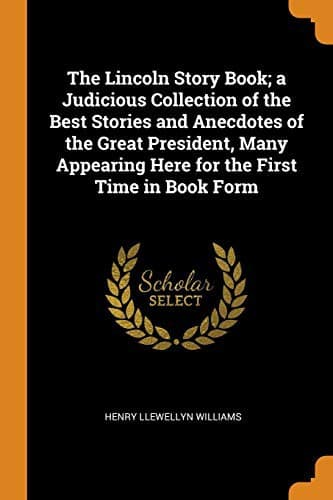
The Lincoln Story Book: A Judicious Collection of the Best Stories and Anecdotes of the Great President, Many Appearing Here for the First Time in Book Form
History
The Lincoln Story Book: A Judicious Collection of the Best Stories and Anecdotes of the Great President, Many Appearing Here for the First Time in Book Form
Lincoln, Abraham, 1809-1865 -- Anecdotes
William Lloyd Garrison, the premier Abolitionist, was imprisoned in
Baltimore for his extreme utterances when a stronghold of the
pro-slavery party. After the war, he visited the regenerated city, and,
for curiosity, sought unavailingly the jail where he had been confined.
On hearing the fruitlessness of his quest, the President said:
"Well, Mr. Garrison, when you first went to Baltimore, you could not
get out of prison--but this second time you could not get in!"
* * * * *
"THEM THREE FELLERS AGIN!"
The gamut of possible atrocities in connection with fulfilment of the
threats of secession being run through the rumors became stale and
flat. Lincoln, receiving one deputation of alarmists with considerable
calm, no doubt thought to excuse it by saying:
"That reminds me of the story of the schoolboy. He found great
difficulty in pronouncing the names of the three children in the fiery
furnace. Yet his teacher had drilled him thoroughly in 'Shadrach,
Meshach, and Abednego,' so that, one day, he purposely took the same
lesson in Bible reading, and managed to have the boy read the passages
containing these names again. As the dull pupil came to them he
stopped, looked up, and said:
"'Teacher, there's them three fellers ag'in!'"
* * * * *
LINCOLN THE GREAT AND LINCOLN THE LITTLE.
In 1856, the new Republican party tested its strength by offering a
ticket: General Fremont, popular through his invasion of California and
Rocky Mountain exploration, was selected as the presidential nominee,
with Dayton as vice. But during the balloting, Lincoln was opposed to
the latter, and received over a hundred votes. This news was despatched
to Illinois as a compliment to her "favorite son."
But on going to congratulate "our Lincoln," the deputation found him
easy and incredulous on the felicitation.
"You are barking up the wrong tree, neighbors," he said gravely; "that
must be the great Lincoln--of Massachusetts."
There was a Levi Lincoln, to whom he had been introduced as a form and
as a kinsman of the Massachusetts Lincolns. So the namesake's mistake
in modesty was pardonable in one who studied the train of politics most
thoroughly since he had said he would be President of these United
States. It was in his teens, but the saying is common property of young
America, and it is more notable that before he left Indiana, and early
in his new and unalterable one in Illinois, his astounded admirers
prophesied the same goal; it is a fact that his own hand proves; that
in 1854, he says, "I have really got it into my head to be United
States senator." [Footnote: Nevertheless, a friend, Speed or Herndon,
says, a year or two later, that Lincoln had no more founded idea that
he would be President than Emperor of China. It may be permitted to
believe that no man is a confidant to his valet or friend.]--(Letter to
Joseph Gillespie, preserved in Missouri Historical Society Library.)
Public-domain text, read in full here on John Shaqi.
Reviews
Reviews
No reviews yet
Be the first to share your thoughts on this work.
Elsewhere in the archive
Join the Discussion
Join the discussion
Sign in to leave a comment or review.
Sign InorCreate an account