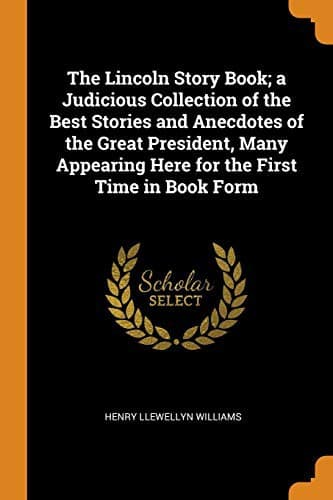
The Lincoln Story Book: A Judicious Collection of the Best Stories and Anecdotes of the Great President, Many Appearing Here for the First Time in Book Form
History
The Lincoln Story Book: A Judicious Collection of the Best Stories and Anecdotes of the Great President, Many Appearing Here for the First Time in Book Form
Lincoln, Abraham, 1809-1865 -- Anecdotes
In 1864, a soldier at work on the Baltimore defenses, an outbreak of
Southern sympathizers being apprehended, attended a Democratic meeting
and made a speech there in favor of its principles and General
McClellan as the standard-bearer. Secretary of War Stanton, fierce like
all apostates, turned on this Democrat, and his disgrace as to the army
was threatened. Captain Andrews went to the fountain-head with his
remonstrance. He was right, for Lincoln said:
"Andrews has as good a right to hold onto his Democracy, if he chooses,
as Stanton had to throw his overboard. No; when the military duties of
a soldier are fully and faithfully performed, he can manage his
politics his own way!"
* * * * *
A TIME THAT TRIED THE SOUL.
It was the Pennsylvania governor, Curtin, who brought the bad news from
Fredericksburg battle-field, where Burnside was repulsed in December,
1862.
"It was a terrible slaughter--the scene a veritable slaughter-pen."
This blunt trope stirred up Lincoln, who had been a pig-slaughterer in
his day, remember. He groaned, wrung his hands, and "took on" with
terrible agony of spirit.
"I remember his saying over and over again," says the governor: "'What
has God put me in this place for?'"
* * * * *
"CABINET" TALK.
Like all persons whose early life was passed in seclusion from the
exhibitions common in society eager for anything to animate jaded
nerves, Mr. Lincoln at Washington sought distractions in his brief
intervals for them. One of the _shows_ he tolerated--he called all
sights so--was the séances of Charles E. Shockle--"Phoebus! what a
name!" This medium came to the capital in 1863, under eminent auspices,
and the President and his wife, members of the Cabinet, and other first
citizens were induced to patronize the illusions. The spirits were
irreverent, "pinching Stanton's and plucking Welles' beard." As for the
President, a rapping at his feet announced an Indian eager "to
communicate."
"Well, sir," said the President, "happy to hear what his Indian majesty
has to say. We have recently had a deputation of the red Indians, and
it was the only deputation, black, white, or red, which did not
volunteer advice about the conduct of the war!"
The writing-under-cover trick was played. A paper covered with Mr.
Stanton's handkerchief was found before the President, scrawled with
marks interpreted as advice for action, by Henry Knox--no one knew
him--but the lecturer said he was the first secretary of war in the
Revolution. The recipient said it was not Indian talk!
He transferred it to Mr. Stanton as concerning his province. He asked
for General Knox's forecast as to when the rebellion would be put down.
The reply was a jumble of wild truisms purporting to be from great
spirits, from Washington to Wilberforce.
Public-domain text, read in full here on John Shaqi.
Reviews
Reviews
No reviews yet
Be the first to share your thoughts on this work.
Elsewhere in the archive
Join the Discussion
Join the discussion
Sign in to leave a comment or review.
Sign InorCreate an account