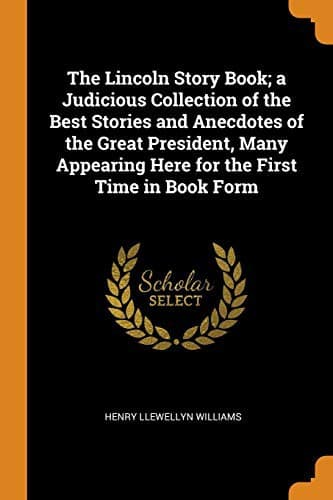
The Lincoln Story Book: A Judicious Collection of the Best Stories and Anecdotes of the Great President, Many Appearing Here for the First Time in Book Form
History
The Lincoln Story Book: A Judicious Collection of the Best Stories and Anecdotes of the Great President, Many Appearing Here for the First Time in Book Form
Lincoln, Abraham, 1809-1865 -- Anecdotes
By treachery of those in charge of our navy-yards, arsenals, and
treasury, the South began the bloody strife better provided than the
simple North. But adverse fate seemed bent on keeping the disparity for
long in favor of the weaker contestant. By one of those wicked
dispensations tripping up our early march, the secretary of the navy
was selected in Gideon Welles, an estimable gentleman in person, but
wofully unsuited to the berth, if from age alone. Patriarchal in
appearance, with a long face and longer beard, white and sere, it
became proverbial without appearing much of a far-fetched joke that he
was the naval constructor to Noah of Ark-aic fame. Unfortunately his
"set" were antiques as well. Yet Lincoln clung to him--or he clung to
the President like the Old Man of the Sea--under which aspect he was
presented by the caricaturists. One day, however, said the gossips of
the White House, Mr. Lincoln dropped the newspaper in reading, and
exclaimed:
"Listen!" said he to his secretary, "a man has been _run over by a
hearse_! As I saw Welles not so long ago, it must be one of _Gideon's_
Band!"
A song entitled "Gideon's Band," introduced by the negro minstrels in
New York, was popular on the streets and in the camps.
* * * * *
BLOOD-SHEDDING REMITS SINS.
Judge Kellogg, having an application for condoning a death sentence
against a soldier, urged that he had served well hitherto, having been
badly wounded under fire.
"Kellogg," remarked Lincoln quickly, "is there not something in the
Bible about the shedding of blood for the remission of sins?"
As the judge was not familiar with ecclesiastical law, he merely bowed.
In fact, the blood-offerings of the ancients was of animals, and it was
deemed profane to offer one's own. Still, the offering of blood is
dedication to a friend or the country. Lincoln had _the idea_ correctly.
"That's a good point," he brightly said, "and there is no going behind
it!"
So saying, he wrote the pardon, which Kellogg transmitted to the
gladdened father of the culprit.
Mr. Lincoln had no need to go back to Scripture for his defense. It is
martial law, unwritten but valid, that if a delinquent soldier,
fugitive from justice, or breaking prison, reaches the battle-field and
takes his place gallantly, no more would be said about the hanging
charge, even though it were literally a hanging one.
* * * * *
HIS "LEG CASES."
Public-domain text, read in full here on John Shaqi.
Reviews
Reviews
No reviews yet
Be the first to share your thoughts on this work.
Elsewhere in the archive
Join the Discussion
Join the discussion
Sign in to leave a comment or review.
Sign InorCreate an account