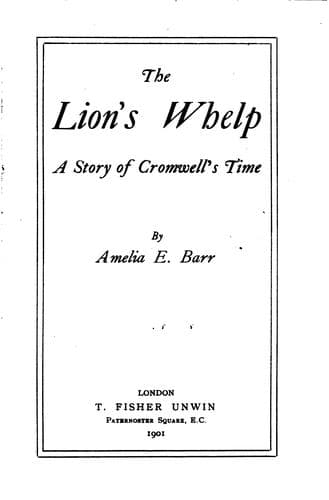
The Lion's Whelp: A Story of Cromwell's TimeBarr, Amelia E.
History
The Lion's Whelp: A Story of Cromwell's Time
Barr, Amelia E.
Great Britain -- History -- Stuarts, 1603-1714 -- Fiction
Then Jane felt a sudden anger at the de Wick family. All her life, in
some way or other, it had been the de Wicks. Matilda’s exactions and
provoking words and ways came to her memory and brought with them a
sense of too much endured. Stephen’s love had ever been a selfishly
disturbing element. Many an unpleasant day it had caused her, and at
this moment she told herself that, say what they would, the Earldom had
an unacknowledged power over the imagination of all the Swaffhams but
herself. She was just going to voice this opinion, when her mother’s
weary face arrested her words; she went away without justifying herself
or her lover, and when the act of self-denial had been accomplished, she
was glad of it. In the stillness of her room she retired with Him who
is a sure hiding-place, and there found that peace which "soft upon the
spirit lies, as tired eyelids upon tired eyes." Her soul sat light and
joyful on its temporal perch, for she had been with God, and all the
shadows were gone. Men and women who have this supernatural element in
them, will understand; to those who are without it, there are no words,
there are no miracles which could authenticate this _intimate_,
spiritual communion to them.
The next day Cymlin went to Jevery House and reported, on his return,
its forlorn emptiness. There were only two or three servants there, and
they had no idea when the family would return. To Jane he admitted that
London seemed desolate, and Jane was herself conscious of a want or a
loss. Much of her London life had been blended with Jevery House, and
there was now a necessity for a fresh ordering of her time and duties.
About a week after Matilda’s departure Cluny called early one evening
and asked Jane to go with him to Mr. Milton’s house in Petty France.
They sauntered through St. James’ Park, not then open to the public in
general, though an exception was made in favour of certain houses on the
Westminster side. In one of these, "a pretty garden house," Mr. Milton
lived, and they found him walking with his daughters under the shady
elms. Cluny delivered to him some papers, but did not accept his
invitation to enter the house and sing with him an anthem which he had
just composed; for the evening promised to be exceedingly lovely, and
Jane’s company in the sweet, shady walks was a far greater attraction.
Public-domain text, read in full here on John Shaqi.
Reviews
Reviews
No reviews yet
Be the first to share your thoughts on this work.
Elsewhere in the archive
Join the Discussion
Join the discussion
Sign in to leave a comment or review.
Sign InorCreate an account