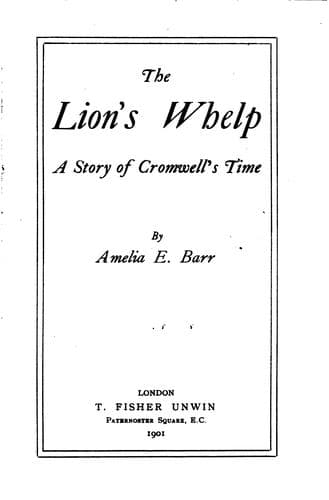
The Lion's Whelp: A Story of Cromwell's TimeBarr, Amelia E.
History
The Lion's Whelp: A Story of Cromwell's Time
Barr, Amelia E.
Great Britain -- History -- Stuarts, 1603-1714 -- Fiction
"In a few minutes the question for passing the bill was put, and the man
could be restrained no longer. He stood up, took off his hat, and
looked round the House, and it quailed under his eyes; every man in it
shifted on his seat and was uneasy. He began to speak, and it was with
a tongue of flame. He reproached them for their self-seeking and their
hypocrisy and oppression; and as he went on, there was the roar of a
lion in his voice, and the members, being condemned of their own
consciences, cowered before him."
"Did no one open their mouth against him?"
"No one but Sir Peter Wentworth. He said, ’My Lord General, this
Parliament has done great things for England;’ and Cromwell answered,
’The spoke in the wheel that creaks most does not bear the burden in the
cart!’ Then Sir Peter told Cromwell his abuse of the Parliament was the
more horrid because it came from the servant of the Parliament, the man
they had trusted and obliged."
At these words Dr. Verity laughed loudly—"Cromwell, the servant of such
a Parliament!" he cried. "Not he; what then, Israel?"
"He told Wentworth to be quiet. He said he had heard enough of such
talk, and putting on his hat, he took the floor of the House. I watched
him as he did so. He breathed inward, like one who has a business of
life and death in hand. I could see on his face that he was going to do
the deed that had been the secret of his breast for many days; and his
walk was that quick stride with which he ever went to meet an enemy. He
stood in the middle of the House, and began to accuse the members
personally. His words were swords. He flung them at the men as if they
were javelins; shot them in their faces as if from a pistol; and while
rivers run to the sea, I can never think of Oliver Cromwell as I saw him
this day but as one of the Immortals. He did not look as you and I
look. He filled the House, though a less man in bulk and stature than
either of us. He told the members to empty themselves of Self, and then
they would find room for Christ, and for England. He told them the Lord
had done with them. He said they were no Parliament, and that he had
been sent to put an end to their sitting and their prating.
"And at these words, Cluny Neville spoke to the Serjeant, and he opened
the doors, and some musketeers entered the House. Then Sir Harry Vane
cried out, ’This is not honest;’ and Cromwell reminded him of his own
broken promise. And so, to one and all, he brought Judgment Day; for
their private lives were well known to him, and he could glance at Tom
Challoner and say, ’Some of you are drunkards;’ and at Henry Marten, and
give the text about lewd livers; and at the bribe-takers he had only to
point his finger, and say in a voice of thunder ’_Depart_,’ and they
began to go out, at first slowly, and then in a hurry, treading on the
heels of each other."
"What of Lenthall? He has a stubborn will."
Public-domain text, read in full here on John Shaqi.
Reviews
Reviews
No reviews yet
Be the first to share your thoughts on this work.
Elsewhere in the archive
Join the Discussion
Join the discussion
Sign in to leave a comment or review.
Sign InorCreate an account