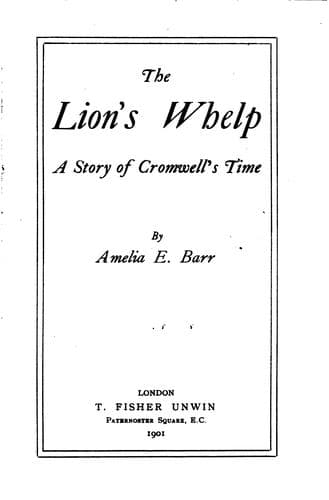
The Lion's Whelp: A Story of Cromwell's TimeBarr, Amelia E.
History
The Lion's Whelp: A Story of Cromwell's Time
Barr, Amelia E.
Great Britain -- History -- Stuarts, 1603-1714 -- Fiction
"There are no results," said the ex-Queen, with a gay laugh and a shrug
of her shoulders. "And I am told he has learned magic among the
Africans, and brought home blackamoors and finer monkeys than my own. I
object to nothing, since he assures me of his undying love for myself
and the Protestant religion. I assure you, if he did not love the
Protestant religion I should find no difficulty in renouncing him."
"He was too well educated in his religion to forget it, madame," said
the Princess Louise.
"I am not to blame if it were otherwise. I assure you he knows his
Heidelberg Catechism as well as any Doctor of Divinity, and the History
of the Reformers is at his tongue’s end. I am not in health to go
regularly to church, but my children go without omission, and they give
me the points of the sermon in writing. I do my duty to them; and of
Rupert I had once great hopes, for the first words he ever spoke were
’Praise the Lord,’ in the Bohemian tongue. After that, one does not
readily think evil of a Prince."
Every day Matilda adroitly induced such conversations; and once when the
mother had talked herself into an enthusiasm, she said, "Come and I will
show you some pictures of this Rupert. His sister Louise makes
portraits quite equal to those of her master, Honthorst. I may tell you
frankly, we have sold her pictures for bread often; they are said to be
Honthorst’s, but most often they are the work of the Princess Louise.
The poor child! she paints and she paints, and forgets that she is a
Palatine Princess without a thaler for her wardrobe. Look at this
portrait of Rupert! Is he not a big, sturdy boy? He was only four
then, but he looks eight. How full of brave wonder are those eyes, as
he looks out on the unknown world! And in this picture he is fourteen.
He does not appear happy. No, but rather sad and uncertain, as if he
had not found the world as pleasant as he expected. In this picture he
is seventeen, gallant and handsome and smiling. He has begun to hope
again,—perhaps to love. And look now on this face at twenty-nine; he
has carried too heavy a burden for his age, done too much, suffered too
much."
Matilda knew the latter portrait well, its facsimile lay upon her heart;
and though she did not say a word, it was impossible not to notice in
all the painted faces that strange, haunting Stuart melancholy, which
must have had its root in some sorrowful, unfathomable past.
Public-domain text, read in full here on John Shaqi.
Reviews
Reviews
No reviews yet
Be the first to share your thoughts on this work.
Elsewhere in the archive
Join the Discussion
Join the discussion
Sign in to leave a comment or review.
Sign InorCreate an account