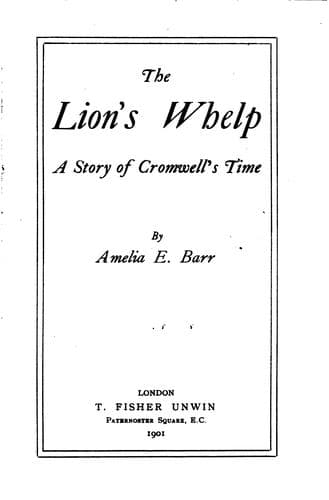
The Lion's Whelp: A Story of Cromwell's TimeBarr, Amelia E.
History
The Lion's Whelp: A Story of Cromwell's Time
Barr, Amelia E.
Great Britain -- History -- Stuarts, 1603-1714 -- Fiction
A moment later the footsteps were very distinct; they were ascending the
stairway quickly, peremptorily—the tread of impatience where all
obstacles have been removed. A perfectly ravishing light spread itself
over Matilda’s face. A moment was an hour. Then the door flew open and
Prince Rupert entered; "entered," however, being too small a word, for
with the opening of the door he was on his knees at Matilda’s feet, his
arms were round her waist, she had bent her face to his, they were both
near to weeping and knew it not; for love must weep when it snatches
from some hard Fate’s control the hours that years have sighed for.
"Adorable Mata! O lovely and beloved! O my love," he sighed. "O Mata,
my flower! my wine! my music! my sacred secret!"
She kissed him, and made him rise. And he told her again, all the
waste, weary remembrance of his life apart from her, and showed her the
long tress of hair which had kept for him the kisses and vows of long
ago. And with what sweet sighs she answered him! Her tender eyes, her
happy mouth, her soft tones, her gentle touch, were all tokens from her
heart’s immediate sanctuary. Amid the sins and sorrows and shows of
Paris, there was paradise for two hearts in the Hotel de Fransac.
In these days men and women did really live and die for love, and a
lover who did not fall at his mistress’ feet was held graceless and
joyless, and without natural fervour. And Rupert could do everything in
excess and yet be natural, for all his being was abnormally developed;
his gigantic stature, his passionate soul, his unreasoning love, his
reckless bravery, his magnificent generosity, his bitter enmities, were
all points in which he offended against the usual standard—though it was
a large standard, if measured by the conventions of the present day. He
had been dangerously ill after his arrival in Paris, and he was not the
Rupert who had invaded the high seas three years previously. In these
three years he had endured every evil that tempests, bad climates, war,
fever, want of food and "strange hardnesses" of all kinds could bring
him; and above all he had practically failed in everything. He had lost
most of the treasure so hardly won; his ships and his men and his
idolised brother, Maurice; and all these losses had taken with them some
of the finer parts of his nature. He had come home a disappointed and
cynical man, his youth melted away in the fiery crucible of constant
strife with human and elemental forces.
Public-domain text, read in full here on John Shaqi.
Reviews
Reviews
No reviews yet
Be the first to share your thoughts on this work.
Elsewhere in the archive
Join the Discussion
Join the discussion
Sign in to leave a comment or review.
Sign InorCreate an account