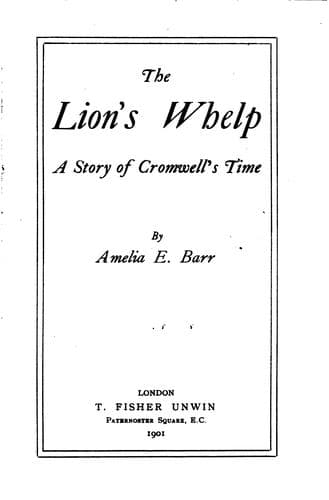
The Lion's Whelp: A Story of Cromwell's TimeBarr, Amelia E.
History
The Lion's Whelp: A Story of Cromwell's Time
Barr, Amelia E.
Great Britain -- History -- Stuarts, 1603-1714 -- Fiction
Then Matilda described the young lord, and the particularity of her
knowledge regarding his eyes and hair and voice and manner did not
please Prince Rupert. At least, he affected to be jealous of such
intimate observation, and for a few minutes the affairs of Cromwell and
Mazarin were forgotten in one of those whiffs of displeasure with which
lovers season their affections. But during it, Matilda had felt obliged
to speak disparagingly and disagreeably of Neville, and she was only too
sensible afterwards of all the ill-will she had expressed. In putting
the dormant dislike into words, she had brought it into actual
existence.
"A very haughty youth," said Rupert when the conversation was resumed.
"He was with the Cardinal this morning, and bore himself as if he
carried the honour of England on his shoulders. And now I begin to
remember his business was such as in a manner concerns us. ’Twas about
a merchant ship which that old farmer on King Charles’ throne wants
payment for. My men took it in fair fight, and ’tis against all usage
to give back spoils. The demands of Cromwell are beyond measure
insolent, and the goods are gone and the ship is sold and the money
scattered, and what can old Ironsides do in the matter?"
They talked of these things until Rupert’s engagements called him away,
then they rose, and leaning towards each other, walked slowly down the
long splendid room together. Large mirrors repeated the moving picture
they made, and before one of them Rupert stood, and bid Matilda survey
her own beauty. It was very great and bewitching, and its effect was
certainly heightened by the handsome, picturesque figure at her side.
There he kissed her with the fondest love and pride, promising an early
visit on the following day.
She went then to find her uncle and aunt, for she knew that she owed to
their love and generosity her present opportunities, and though her
gratitude had in it, very likely, a certain sense of favours to come,
she was really pleased and thankful for the happiness present and within
her reach. But she quickly noticed in them an air of anxiety and gloom,
and it annoyed her. "Could she never be happy and find all her
surroundings in key with her? It was too bad!" Such thoughts gave a
tone of injury to her inquiry, "Is anything particularly wrong, aunt?
Have I been making some trouble again?"
"Sir Thomas is very unhappy, niece. He has heard news that frightens
him, and we are longing to be in the peace and safety of our own home."
Then Matilda began to complain. "As soon as a joy is at my hand, it is
taken away," she said. "And what a lovely city is Paris! How can any
one want to leave it and go to London? It is cruel. It is beyond
bearing!"
Public-domain text, read in full here on John Shaqi.
Reviews
Reviews
No reviews yet
Be the first to share your thoughts on this work.
Elsewhere in the archive
Join the Discussion
Join the discussion
Sign in to leave a comment or review.
Sign InorCreate an account