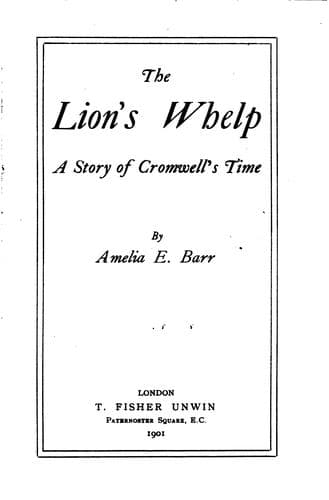
The Lion's Whelp: A Story of Cromwell's TimeBarr, Amelia E.
History
The Lion's Whelp: A Story of Cromwell's Time
Barr, Amelia E.
Great Britain -- History -- Stuarts, 1603-1714 -- Fiction
Then the old man burst into that thin, cold passion of weeping so
significant of age, and so pitiful in its helplessness. "It is your
father’s doing, Lady Matilda," he sobbed. "It is my dear lord’s wisdom.
Pardon me now. This evening I will tell you all." He went away with
these words, and the two women looked at each other in amazement.
In the evening he came to them. They were sitting by the fire in the
now magnificently furnished great salon, and he asked permission to
place his chair between them. Matilda made room for him, and when he had
sat down and placed his terribly thin hand on its arm, she laid her
lovely young hand upon his; and he looked into her face with that
adoring affection which is often seen in the eyes of a favourite
mastiff.
"When these dreadful wars first began," he said, "Earl de Wick foresaw
their ending; and after Marston Moor he said to me, ’I know this man,
Oliver Cromwell, and there is none that will stand against him. It is
my duty to save de Wick; will you help me?’ And I said to him, ’My dear
lord, I owe you all I am, and all I have.’ Then we had many long talks,
and it was agreed that I should join the Puritan party, that I should
pretend a disapproval of the Earl and his ways—but a disapproval
tempered with regret—so that men might not suspect my opposition. The
King was even then sending to de Wick for money, and I was supposed to
supply it on the de Wick silver and valuables. In reality, the Earl
sent these things to my care, and he himself gave the gold. For in
those years he had much specie, the result of his trading partnership
with Sir Thomas Jevery. The silver, the old pictures, the fine
tapestries, and Eastern pottery all came to my home in St. Ives. People
said unkind things of me, but my dear lord loved me. Then there came a
time when de Wick was bare, and the King still wanted money. And the
Earl promised to borrow from me one thousand pounds, in consideration of
letters royal making the Lady Matilda Countess de Wick in her own right,
if her brother Stephen had no heirs of his body. His Majesty being in
great straits, readily granted the request, and the proper papers were
made. And I looked well to it that no necessary formality was lacking,
and the thousand pounds were paid, not by me, but by Earl de Wick. His
store was then gone, but he had secured the succession of de Wick in his
own blood and name; for you will see, my dear lady, if ever you have to
assume this title, when you marry, your husband must take the name of de
Wick."
"But if I never marry any one?"
"Oh, that is an impossible contingency! You would owe that debt to all
the de Wicks that ever lived and died; and you would pay it, whether you
liked to, or not."
"Yes, I should," she answered promptly.
Public-domain text, read in full here on John Shaqi.
Reviews
Reviews
No reviews yet
Be the first to share your thoughts on this work.
Elsewhere in the archive
Join the Discussion
Join the discussion
Sign in to leave a comment or review.
Sign InorCreate an account