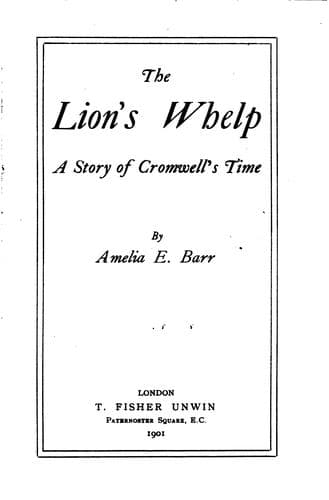
The Lion's Whelp: A Story of Cromwell's TimeBarr, Amelia E.
History
The Lion's Whelp: A Story of Cromwell's Time
Barr, Amelia E.
Great Britain -- History -- Stuarts, 1603-1714 -- Fiction
At this point Matilda rose and went into an adjoining parlour, and
Cymlin followed her. Lady Jevery, reclining in her chair, closed her
eyes, and the Doctor and Sir Thomas continued their conversation on
Cromwell and on political events with unabated spirit until Lady Jevery,
suddenly bringing herself to attention, said—
"All this is very fine talk, indeed; but if this great Oliver has
ambassadors from every country seeking his friendship, if he has the
wily Mazarin at his disposal, why can he not find out something about
that poor Lord Neville? It was said when we were in Paris that Mazarin
knew every scoundrel in France, and knew also how to use them. Let him
find Neville through them. Has Colonel Ayrton returned, or is he also
missing?"
"He returned some time ago. He discovered nothing of importance. It is
certain that Neville left the Mazarin palace soon after noon on the
seventh of last November; that he went directly to the house in which he
had lodged, eat his dinner, paid his bill, and gave the woman a silver
Commonwealth crown for favour. She showed the piece to Ayrton, and said
further that, soon after eating, a gentleman called on Neville, that in
her presence Neville gave him some letters, and that after this
gentleman’s departure, Neville waited very impatiently for a horse which
he had bought that morning, and which did not arrive on time; that when
it did arrive, it was not the animal purchased, but that after some
disputing, Neville agreed to take the exchange. The horse dealer was a
gypsy, and Ayrton spent some time in finding him, and then in watching
him. For Ayrton judged—and I am sure rightly—that if the gypsy had
followed and slain and robbed Neville, he could not refrain himself from
wearing the broidered belt and sapphire ring of his victim. Besides
which, your jewels would have been given to the women of his camp. But
no sign of these things was found—kerchief, or chain or purse, or any
trifle that had belonged to the unfortunate young man."
"Was there any trace of him after he left Paris?"
"Yes. Ayrton found out that he stayed half-an-hour at a little inn
fourteen miles beyond Paris to have his horse fed and watered. One of
the women at this house described him perfectly, and added that as he
waited he was singing softly to himself, a thing so likely, and so like
Cluny, that it leaves no doubt in my mind of his identity; and that he
was really there ’between gloaming and moonshine’ on the eleventh of
last November. Beyond that all is blank—a deaf and dumb blank."
"How far was it to the next house?"
"Only two or three miles; but no one there remembered anything that
passed on that night. They said that horsemen in plenty, and very often
carriages, were used to pass that way, but that unless they stopped for
entertainment, no attention was paid to travelers."
"Who was the gentleman who visited Cluny and received his letters?"
Public-domain text, read in full here on John Shaqi.
Reviews
Reviews
No reviews yet
Be the first to share your thoughts on this work.
Elsewhere in the archive
Join the Discussion
Join the discussion
Sign in to leave a comment or review.
Sign InorCreate an account