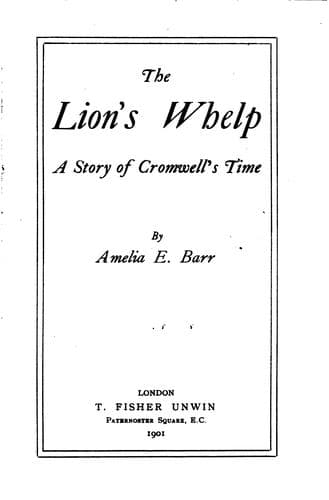
The Lion's Whelp: A Story of Cromwell's TimeBarr, Amelia E.
History
The Lion's Whelp: A Story of Cromwell's Time
Barr, Amelia E.
Great Britain -- History -- Stuarts, 1603-1714 -- Fiction
"If I tell about the duel with Rupert," she thought, "it can do no good
to the dead, and it may make scandal and annoyance for the living.
Cromwell will take hold of it, and demand not only the jewels and money
and papers, but also the body of Neville. That will make more ill
feeling to the Stuarts, and it is manifest they are already very
unwelcome with the French Court. It will be excuse for further
unkindness, and they have enough and more than enough to bear."
For a long time she sat musing in this strain, battling down intrusive
doubts, until at last she was forced to give them speech. She did so
impatiently, feeling herself compelled to rise and walk rapidly up and
down the room, because motion gave her a sense of resistance to the
thoughts threatening to overwhelm her.
"Did Rupert kill Neville?" she asked herself. "Oh, me, I do fear it.
And if so, I am to blame! I am to blame! I told Rupert Neville was
going to take charge of my aunt’s jewels. Why was I such a fool? And
Rupert knew that Neville had papers Charles Stuart would like to see,
and money he would like to have. Oh, the vile, vile coin! I do fear
the man was slain for it—and by Rupert. He lied to me, then; of course
he lied; but that was no new thing for him to do. He has lied a
thousand times to me, and when found out only laughed, or said ’twas for
my ease and happiness, or that women could not bear the truth, or some
such trash of words; and so I was kissed and flattered out of my
convictions. Faith in God! but I have been a woman fit for his
laughter! What shall I do?" She went over and over this train of
thought, and ended always with the same irresolute, anxious question,
"What shall I do?"
It was not the first time she had accused Rupert in her heart. She knew
him to be an incomparable swordsman; she knew he regarded duelling as a
mere pastime or accident of life. The killing of Neville would not give
him a moment’s discomfort,—quite otherwise, for he was a trifle jealous
of him in more ways than one; and there were money and information to be
gained by the deed. Politically, the man was his enemy, and to kill him
was only "satisfaction." The story Rupert told her of the duel had
always been an improbable one to her intelligence. She did not believe
it at the time, and the lapse of time had impaired whatever of
likelihood it possessed.
Public-domain text, read in full here on John Shaqi.
Reviews
Reviews
No reviews yet
Be the first to share your thoughts on this work.
Elsewhere in the archive
Join the Discussion
Join the discussion
Sign in to leave a comment or review.
Sign InorCreate an account