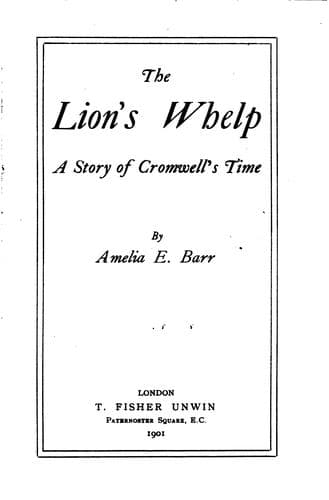
The Lion's Whelp: A Story of Cromwell's TimeBarr, Amelia E.
History
The Lion's Whelp: A Story of Cromwell's Time
Barr, Amelia E.
Great Britain -- History -- Stuarts, 1603-1714 -- Fiction
"King! King! I am king in very truth, call me what they like. And for
that matter, why should I not be king? Doctor Owen tells me the word
king comes from König and means ’_the man that can_.’ I am that man.
Every king in Europe came from some battle-field, that was their first
title to kingship. Our William, called the Conqueror, won the Kingdom
of England by one successful battle. How many battles have I fought and
won? I never lost a single field—how could I, the Lord of Hosts being
with me? As a hero of battle, there is no man to stand before me. Why
should I not be king over the three countries I have conquered? My
title to kingship is as good as any ruler I know. And perhaps—who can
tell—had I crowned myself, it had been a settlement much needed. John
Verity is right. Englishmen think a protector is a ruler for emergency.
They feel temporary and uncertain with a protector. A kingship is a
settled office. The laws are full of the king; they do not name a
protector—and men feel to the law as they do to a god."
"Take the crown, Oliver. Why not?"
"I have no orders to take it. My angel told me when I was a boy, that I
should become the greatest man in England, but he said not that I should
be king. And I know also from _One_ who never lied to me, that this
nation will yearn after its old monarchy. I am here to do a work, to
sow seeds that will take generations to ripen, but my reign is only an
interregnum. I shall found no dynasty."
"Oh, Oliver! You have two sons."
"Richard cannot manage his own house and servants. Harry is a good
lieutenant; he can carry out instructions, it is doubtful if he could
lead. My desire for my sons is, that they live private lives in the
country. I know what I know. I have what I have. The crown of England
is not to be worn by me, nor do I want it; I do not—neither for myself
nor my children." Then taking his wife’s hand tenderly between his own,
he said with intense fervour, "There is not a man living can say I
sought this place—not a man or woman living on English ground. I can
say in the presence of God, I would have been glad to have lived with
thee under my woodside all the days of my life, and to have kept my
sheep and ploughed my land rather than bear the burden of this
government."
"Do you think the Puritan government will die with you, Oliver?"
"I think it will; but the Puritan principles will never die. The kings
of the earth banded together cannot destroy them. They will spring up
and flourish like ’the grass that tarrieth not for man’—spring where
none has sowed or planted them—spring in the wilderness and in the city,
until they possess the whole earth. This I know, and am sure of."
"Then why are you so sad?"
Public-domain text, read in full here on John Shaqi.
Reviews
Reviews
No reviews yet
Be the first to share your thoughts on this work.
Elsewhere in the archive
Join the Discussion
Join the discussion
Sign in to leave a comment or review.
Sign InorCreate an account