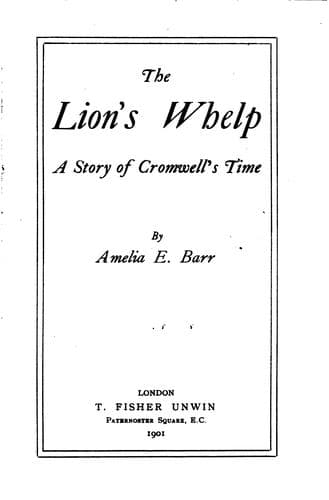
The Lion's Whelp: A Story of Cromwell's TimeBarr, Amelia E.
History
The Lion's Whelp: A Story of Cromwell's Time
Barr, Amelia E.
Great Britain -- History -- Stuarts, 1603-1714 -- Fiction
During the first hours of her discovery, Matilda had wondered if she
ought to tell Jane what proof of Cluny’s death had come to them; for in
her heart she scoffed at the idea of Cluny returning to Paris to sell
the jewels. But Jane did not visit her for some time, and she was daily
expecting an answer from Prince Rupert. This letter might be of great
importance, one way or another, and she resolved to wait for it. It
came more rapidly than she had anticipated, and its contents temporarily
fanned to a feeble flame her dying illusions concerning her first lover.
In this letter Rupert "on his honour" reiterated his first statement.
He declared that he left Neville in health and safety, having at the
last moment urged upon him his own swift Barb, which offer Neville
refused. He said he should seek mademoiselle’s presence until he saw
her wearing the jewels, and then make question concerning them; and if
not satisfied, go at once to her Uncle Mazarin. He was sure it was now
only a few weeks ere the truth would be discovered. These promises were
blended with his usual protestations of undying devotion, and Matilda
was pleased, though she was not satisfied. For to Rupert’s letter there
was a postscript, and in this postscript one word, which sent the blood
to her heart, cold with terror—
"P.S. It may be the _Bastile_, and not the grave, which holds the
Neville secret."
_The Bastile_! She had heard enough in Paris of that stone hell to make
her tremble at the word. And now it kept upon her heart a persistent
iteration that was like blow upon blow. All night she endured it, but
in the morning; she was resolved to throw the intolerable burden on some
one more able to bear it. But on whom? Sir Thomas would not have the
subject named in his presence. Cymlin did not like Neville, and would
probably "talk down" all her fears and efforts. It would be cruel to
tell Jane,—but there was Cromwell. There was the Protector. It was his
business to look after Englishmen, else what was the use of a Protector?
And if any man had power to question the Bastile, Cromwell had it.
Mazarin was just at this time seeking his aid against the Spaniards, who
were on French soil, and Cromwell was about to send his own famous troop
of Ironsides to help the French. Besides which, Cromwell loved Neville.
Taking all these things together, Matilda easily satisfied herself that
interference was Cromwell’s bounden duty, and that all which could be
asked of her was to make Cromwell aware of this duty.
Public-domain text, read in full here on John Shaqi.
Reviews
Reviews
No reviews yet
Be the first to share your thoughts on this work.
Elsewhere in the archive
Join the Discussion
Join the discussion
Sign in to leave a comment or review.
Sign InorCreate an account