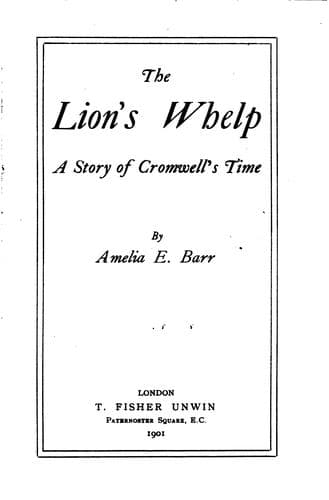
The Lion's Whelp: A Story of Cromwell's TimeBarr, Amelia E.
History
The Lion's Whelp: A Story of Cromwell's Time
Barr, Amelia E.
Great Britain -- History -- Stuarts, 1603-1714 -- Fiction
"Cluny composed psalms and hymns, and tried to sing; he did not lose
heart or hope quite, the gaoler told father, for nearly four years.
Then his health and strength gave out, and his heart failed, but he
never ceased praying. They heard him at midnight, but Cluny did not know
what hour it was. And to the last moment he kept his faith in God. He
was sure God would deliver him, though He sent an angel to open the
prison doors. He was expecting deliverance the day it came. He had had
a message from beyond, and his mother had brought it. Now did I not do
right to marry him when, and how, he wished?"
"Yes," she answered, but her face and voice showed her to be painfully
affected. "Jane, I cannot bear to lose you. I shall have no one to love
me, no one to quarrel with," she added.
"You will have Cymlin."
"Cymlin is Cymlin; he is not you. I will say no more. When a woman is
married, all is over. She must tag after her lord, even over seas and
into barbarous places. If the Indians kill you, it will be said that you
were in the way of duty; but I have noticed how often people take the
way they want to take, and then call it the way of Duty. I shall not
marry Cymlin until he can show me the way of peace and pleasantness."
Then Jane rose to go, and Matilda tied her bonnet-strings, and
straightened out her ribbons and her gloves, doing these trifling
services with a long-absent tenderness that filled Jane’s heart with
pleasure. "Good-bye, dear!" she said with a kiss; "I will come as often
as I can."
"Very kind of you, Lady Neville," answered Matilda with a curtsy and a
tearful mockery; "very kind indeed! But will your ladyship consider—"
then she broke down and threw her arms round Jane, and called her "a
dear, sweet, little Baggage" and bade her give Cluny some messages of
hope and congratulation, and so parted with her in a strange access of
affection. But true friendship has these moods of the individual and
would not be true without them.
Public-domain text, read in full here on John Shaqi.
Reviews
Reviews
No reviews yet
Be the first to share your thoughts on this work.
Elsewhere in the archive
Join the Discussion
Join the discussion
Sign in to leave a comment or review.
Sign InorCreate an account